
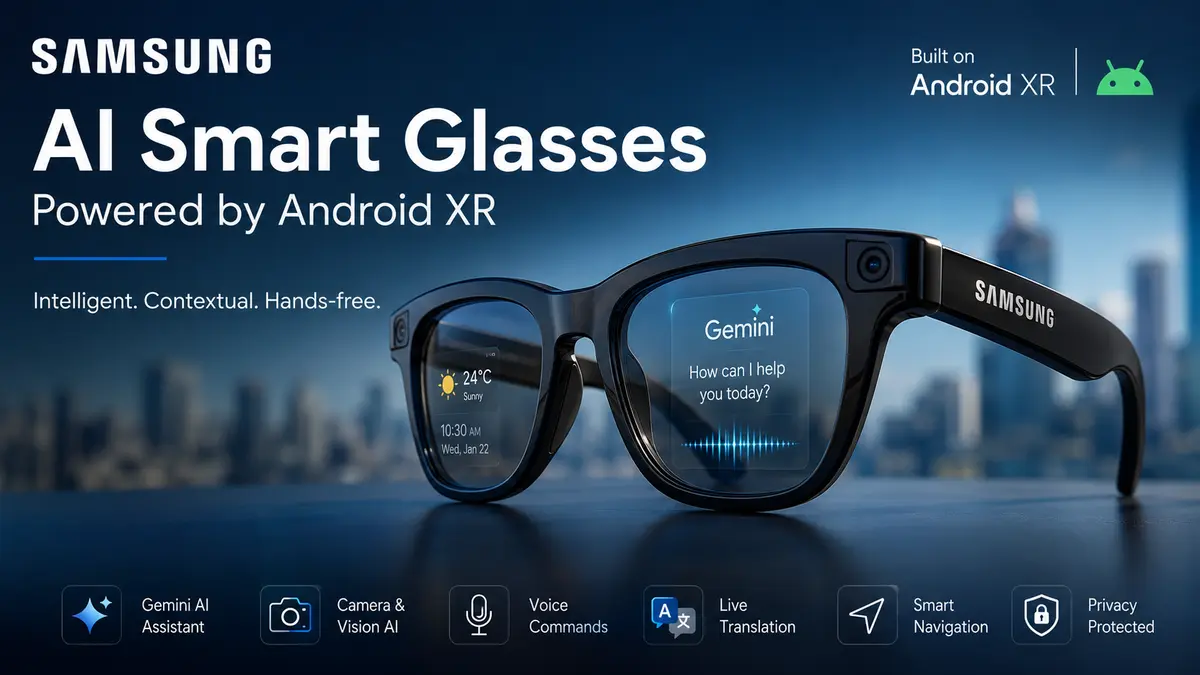
Samsung unveils New AI Smart Glasses Powered By Android XR
Samsung has officially unveiled AI smart glasses powered by Android XR, marking the company’s biggest step yet into the wearable extended reality market. The lightweight glasses combine Google’s Android XR platform, Gemini AI, advanced cameras, microphones, and contextual intelligence to provide hands-free assistance without requiring users to constantly reach for their smartphones. The announcement signals Samsung’s ambition to compete in the rapidly growing AI wearable segment alongside Meta, Apple, and other technology giants.
Samsung’s latest announcement represents far more than another wearable gadget. It reflects a broader industry shift toward AI-powered computing that blends digital information seamlessly into everyday life. Rather than focusing solely on augmented reality visuals, Samsung aims to create intelligent eyewear capable of understanding surroundings, responding naturally to voice commands, and assisting users throughout the day.
Samsung Officially Enters the AI Smart Glasses Market
Samsung has spent the past several years strengthening its position across smartphones, tablets, foldable devices, smartwatches, earbuds, and XR technologies. Until now, however, the company had remained relatively quiet about smart glasses while competitors accelerated development.
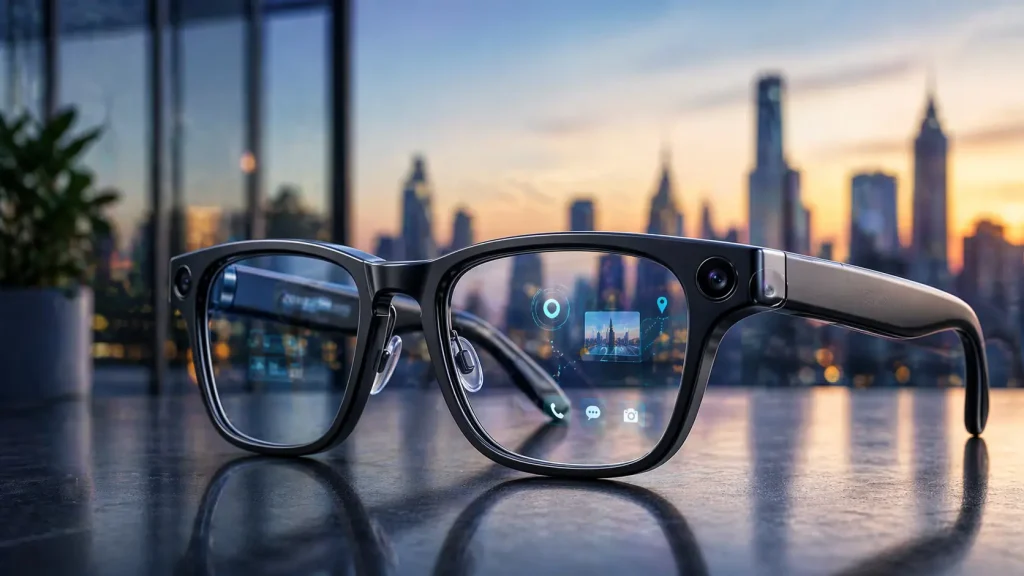
The unveiling of Android XR-powered smart glasses changes that strategy completely.
Instead of introducing a bulky headset designed primarily for gaming or entertainment, Samsung has chosen a lightweight eyewear design intended for everyday use. The company believes wearable AI should become as natural as wearing regular glasses, allowing users to interact with artificial intelligence throughout the day without carrying another handheld device.
The announcement also reinforces Samsung’s long-term collaboration with Google and Qualcomm. Together, the three companies have worked to create an ecosystem that combines powerful hardware, efficient processors, and intelligent software into a unified XR experience.
More Details: Samsung Brings Galaxy Ecosystem Into Everyday Eyewear
What Is Android XR?
Android XR is Google’s new operating system specifically built for extended reality devices. Unlike traditional Android, which primarily powers smartphones and tablets, Android XR is optimized for wearable computing, immersive experiences, mixed reality, and AI-powered interactions.
The platform enables manufacturers such as Samsung to build devices capable of understanding the real world while providing intelligent digital assistance.
Some of Android XR’s core capabilities include:
- Natural voice conversations with Gemini AI
- Real-time environmental awareness
- Spatial computing experiences
- AI-powered object recognition
- Hands-free navigation
- Context-aware recommendations
- Multi-device synchronization
- Support for future augmented reality applications
Rather than treating AI as a separate application, Android XR integrates intelligence throughout the operating system, allowing users to access information naturally through voice, gestures, or contextual prompts.
Samsung’s Vision for Intelligent Eyewear (AI Smart Glasses)
Samsung describes its new smart glasses as “intelligent eyewear” rather than traditional augmented reality glasses.
That distinction is important.
Many earlier smart glasses attempted to project complex holograms into the user’s field of view. Those products often became expensive, heavy, and impractical for everyday use.
Samsung instead focuses on creating wearable AI that understands the user’s surroundings and delivers useful information at the right moment.
Imagine walking through a city while asking:
- “What building is this?”
- “Translate that sign.”
- “Find the nearest coffee shop.”
- “Read today’s calendar.”
- “Take a photo.”
- “Summarize this document.”
Instead of pulling out a smartphone, users simply speak naturally while Gemini processes the request using information from the cameras, microphones, sensors, and cloud intelligence.
This approach reduces friction and makes AI feel like an always-available digital assistant rather than another app.
Gemini AI Is the Heart of Samsung’s AI Smart Glasses
One of the biggest highlights is the deep integration of Google’s Gemini AI.
Rather than offering limited voice commands, Samsung’s glasses use multimodal artificial intelligence capable of understanding voice, images, surroundings, and context simultaneously.
That means Gemini can process what users are looking at while also understanding spoken requests.
For example, if someone is standing in front of a famous landmark, they could ask:
“When was this building constructed?”
Gemini can analyze the camera view, identify the landmark, retrieve relevant information, and provide an answer within seconds.
Similarly, users could point toward a restaurant menu in another language and request an instant translation.
The AI understands both the visual content and the spoken request together.
Context-Aware Intelligence
Unlike conventional voice assistants, Gemini continuously builds contextual understanding.
For instance, it can remember ongoing conversations, understand follow-up questions, and combine multiple information sources before responding.
If a user asks:
“Book a table here for tonight.”
Gemini first identifies the restaurant through the camera, checks availability (where supported), and begins the reservation process without requiring the restaurant’s name.
This contextual awareness significantly reduces the number of commands users need to give.
Hardware Designed for Everyday Wear
Samsung has emphasized comfort as one of the product’s primary design goals.
Unlike bulky XR headsets that remain confined to homes or offices, these smart glasses resemble conventional eyewear, making them practical for extended daily use.
Although Samsung has not disclosed every hardware specification, the company highlighted several core components expected to power the experience.
Lightweight Frame
The glasses feature a slim frame designed to minimize fatigue during long periods of use.
Weight reduction has been a major engineering priority because user comfort directly affects adoption.
Integrated Camera System
The front-facing cameras enable numerous AI-powered functions, including:
- Visual recognition
- Scene understanding
- Instant photography
- Video capture
- Object detection
- QR code scanning
- Live translation
Rather than functioning solely as cameras, these sensors act as the eyes of Gemini AI.
Built-In Microphones
Multiple microphones capture voice commands even in noisy environments.
Advanced noise reduction technology helps isolate the user’s voice for more accurate speech recognition.
Speakers
Instead of requiring earbuds, directional speakers built into the frame allow users to hear AI responses privately while maintaining awareness of their surroundings.
This design also enables navigation guidance, translated conversations, and notifications without covering the ears.
Android XR Creates a Connected Ecosystem
Samsung’s smart glasses are not intended to replace smartphones entirely.
Instead, they extend the Galaxy ecosystem.
Users will likely be able to transition seamlessly between:
- Galaxy smartphones
- Galaxy tablets
- Samsung laptops
- Galaxy Watches
- Galaxy Buds
- Smart TVs
- Android XR devices
This interconnected approach allows tasks started on one device to continue naturally on another.
For example, a navigation route created on a Galaxy smartphone could instantly appear within the smart glasses, while incoming messages could be read aloud through Gemini without removing the phone from a pocket.
The ecosystem also enables synchronized notifications, cloud-based AI processing, and shared applications, creating a more unified user experience across Samsung’s expanding portfolio of connected devices.
AI Features Expected at Launch
Samsung has confirmed that artificial intelligence will be central to the user experience. While the complete software feature set is expected to expand over time, several capabilities have already been highlighted or strongly indicated.
Real-Time Language Translation
One of the most practical features is live translation. Users will be able to look at signs, menus, or printed documents in another language and receive near-instant translations. Voice conversations may also be translated in real time, making international travel and cross-language communication much easier.
Visual Search
Instead of typing search queries, users can simply look at an object and ask Gemini about it.
For example, the glasses could identify:
- Plants and flowers
- Animals
- Historical landmarks
- Consumer products
- Artwork
- Books
- Clothing
- Electronics
This hands-free visual search transforms everyday curiosity into an interactive experience.
Smart Navigation
Navigation becomes more intuitive when directions are delivered through wearable AI. Rather than repeatedly checking a phone, users can receive spoken turn-by-turn guidance while keeping their attention on the road or surroundings.
Location-aware intelligence may also suggest nearby restaurants, attractions, stores, or services based on user preferences and current context.
Instant Information Retrieval
Whether identifying a monument, summarizing a news article, checking calendar appointments, or answering general knowledge questions, Gemini AI can provide relevant information without interrupting the user’s workflow.
The goal is to make accessing information feel as natural as asking a knowledgeable companion standing beside you.
Also read: X Rebuilds New Android App from Scratch: Faster Performance
How Samsung’s AI Smart Glasses Compare With Other AI Wearables
Samsung enters an increasingly competitive market where several technology companies are pursuing AI-powered wearable devices.
| Feature | Samsung Android XR Glasses | Meta Ray-Ban Smart Glasses | Apple Vision Pro |
|---|---|---|---|
| Operating System | Android XR | Meta OS | visionOS |
| AI Assistant | Google Gemini | Meta AI | Apple Intelligence (supported regions) |
| Design | Lightweight everyday glasses | Traditional eyewear | Mixed reality headset |
| Primary Focus | AI assistance and contextual computing | Social sharing and AI | Spatial computing and immersive experiences |
| Cameras | Yes | Yes | Y e s |
| Voice Commands | Yes | Yes | Y e s |
| Hands-Free AI | Yes | Yes | Y e s |
| Daily Wear | Designed for all-day use | Yes | Limited due to headset form factor |
Samsung’s approach differs from Apple’s Vision Pro, which prioritizes immersive mixed reality. Instead, Samsung focuses on making AI available throughout the day in a discreet, lightweight form.
Compared with Meta’s Ray-Ban smart glasses, Samsung benefits from Google’s Gemini AI and the Android XR platform, potentially offering deeper integration with Android devices and a wider ecosystem of applications.
Also read: Grok AI Assistant Comes to Microsoft Office for Free
Potential Everyday Use Cases Of AI Smart Glasses
The real value of AI smart glasses lies in practical, everyday scenarios rather than futuristic demonstrations. Samsung showcased several examples that highlight how the technology can simplify routine tasks.
While Traveling
Travelers could ask for live translations, identify landmarks, receive navigation assistance, or learn about local attractions without constantly checking a smartphone.
At Work
Professionals may use the glasses to:
- Review schedules
- Receive meeting reminders
- Access quick notes
- Summarize emails
- Capture photos or videos hands-free
- Look up technical information while working
During Shopping
Gemini AI could identify products, compare items, provide reviews, or answer questions about features and specifications while users browse in stores.
Education and Learning
Students may benefit from instant explanations of complex concepts, translations of educational material, and contextual information about objects, historical sites, or scientific exhibits.
Accessibility
AI-powered eyewear also has the potential to improve accessibility by assisting users with visual impairments through scene descriptions, text recognition, and spoken guidance.
Expected Availability of Samsung’s AI Smart Glasses
Samsung has confirmed the introduction of its Android XR-powered intelligent eyewear, but the company has not announced a global retail launch date or official pricing.
Industry observers expect Samsung to reveal additional hardware details, supported markets, software capabilities, and availability timelines during future Galaxy events or dedicated XR announcements.
Regional availability may vary, with initial launches expected in selected markets before expanding worldwide.
Also read: Kimi K3 Launch: World’s Largest Open AI Model Explained
Frequently Asked Questions
1. What are Samsung’s AI smart glasses?
Samsung’s AI smart glasses are lightweight intelligent eyewear powered by Google’s Android XR platform. They combine cameras, microphones, speakers, sensors, and Gemini AI to provide hands-free assistance, contextual information, navigation, and voice interactions.
2. What is Android XR?
Android XR is Google’s operating system designed specifically for extended reality devices such as smart glasses and mixed reality headsets. It supports spatial computing, AI-powered experiences, voice interaction, and immersive applications.
3. Does Samsung’s smart glasses use Google Gemini?
Yes. Samsung has integrated Google’s Gemini AI into the glasses, enabling multimodal intelligence that understands voice commands, visual input, and contextual information simultaneously.
4. Will Samsung’s smart glasses replace smartphones?
Not immediately. Samsung positions the glasses as a companion device that works alongside Galaxy smartphones and other connected devices rather than replacing them entirely.
5. Can the glasses translate languages in real time?
Yes. One of the highlighted capabilities is real-time translation of signs, menus, printed text, and potentially spoken conversations, making communication easier while traveling or interacting across languages.
6. When will Samsung’s Android XR smart glasses be available?
Samsung has introduced the product but has not yet confirmed a worldwide release date or official pricing. Additional announcements are expected during future Galaxy or Android XR events.
7. How are Samsung’s smart glasses different from Apple Vision Pro?
Apple Vision Pro is a mixed reality headset designed for immersive spatial computing, while Samsung’s smart glasses emphasize lightweight everyday wear, hands-free AI assistance, and contextual intelligence.
8. Who are Samsung’s biggest competitors in AI smart glasses?
Samsung will compete with companies such as Meta, Apple, Google, Xreal, and other manufacturers investing in AI-powered wearable technology and extended reality devices.
9. Will developers be able to build Android XR apps?
Yes. Android XR is designed as an open platform that enables developers to create applications optimized for wearable AI and extended reality experiences, helping expand the ecosystem over time.
10. Why is Samsung’s announcement important?
The announcement marks Samsung’s official entry into the AI wearable market and highlights the growing importance of intelligent eyewear as a future computing platform. It also strengthens the partnership between Samsung, Google, and Qualcomm in shaping the next generation of AI-powered devices.
Final Thoughts (AI Smart Glasses)
Samsung unveils AI smart glasses powered by Android XR at a pivotal moment for the technology industry. Instead of chasing highly immersive virtual reality alone, the company is focusing on practical artificial intelligence that fits naturally into everyday life.
By combining lightweight hardware, Google’s Android XR operating system, Gemini AI, Qualcomm’s processing technology, and Samsung’s extensive Galaxy ecosystem, the company aims to redefine how people interact with digital information beyond the smartphone.
Although questions remain regarding pricing, battery life, availability, and long-term software support, Samsung’s announcement clearly signals that wearable AI is becoming a central part of the future of personal computing. As Android XR continues to mature, these smart glasses could become one of the most significant developments in the next generation of connected devices.
Also read: Google to Make Gemini 10x More Efficient With New Chips


