
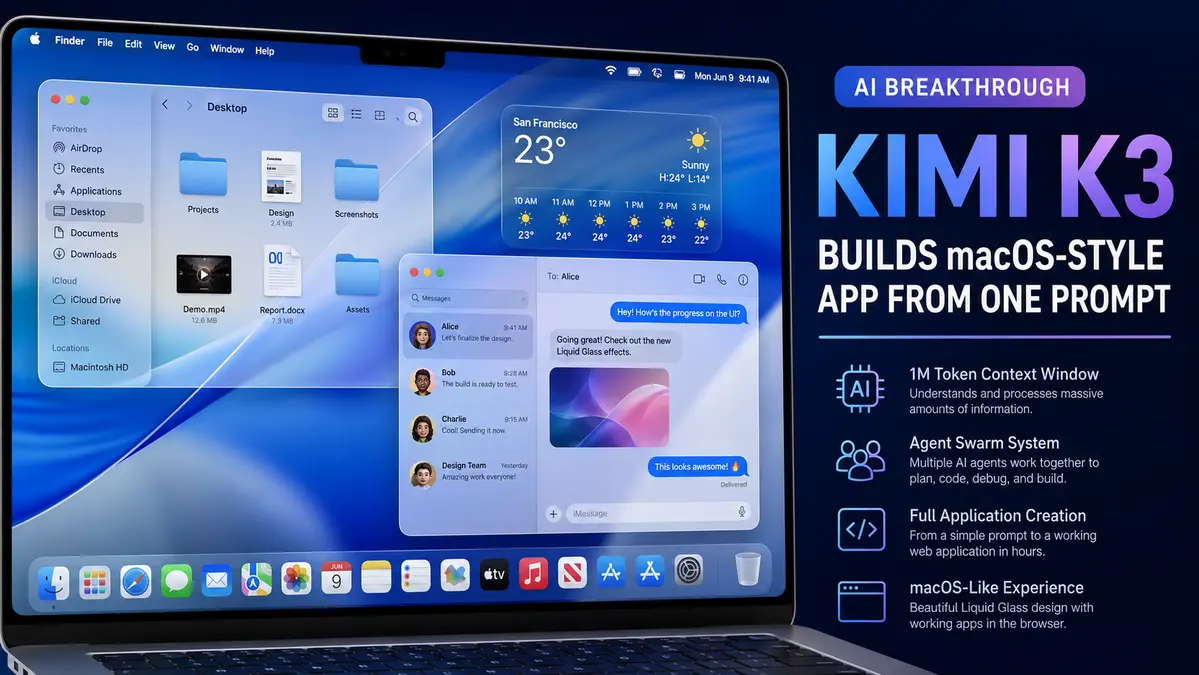
China’s New AI Kimi K3 Can Build Apple OS Without Coding
Kimi K3 has become one of the most talked-about AI models in the technology industry after generating a functional macOS-style web application from a single user instruction. The project, created by an analyst using Kimi K3’s agent-based coding system, demonstrates how modern AI tools are moving beyond simple code generation and toward building complete software experiences.
The demonstration involved asking Kimi K3 to recreate the visual style of Apple’s upcoming macOS design language, including Liquid Glass-style effects and native-looking applications that run inside a web browser. The result was a browser-based interface that closely resembled a modern Mac desktop environment, complete with working apps and interactive elements.
What Happened?
According to the public demonstration, the AI took approximately three hours and twenty minutes to complete the project. The task also consumed a substantial portion of the user’s monthly Kimi usage credits, showing that complex AI-generated software projects still require significant computing resources.

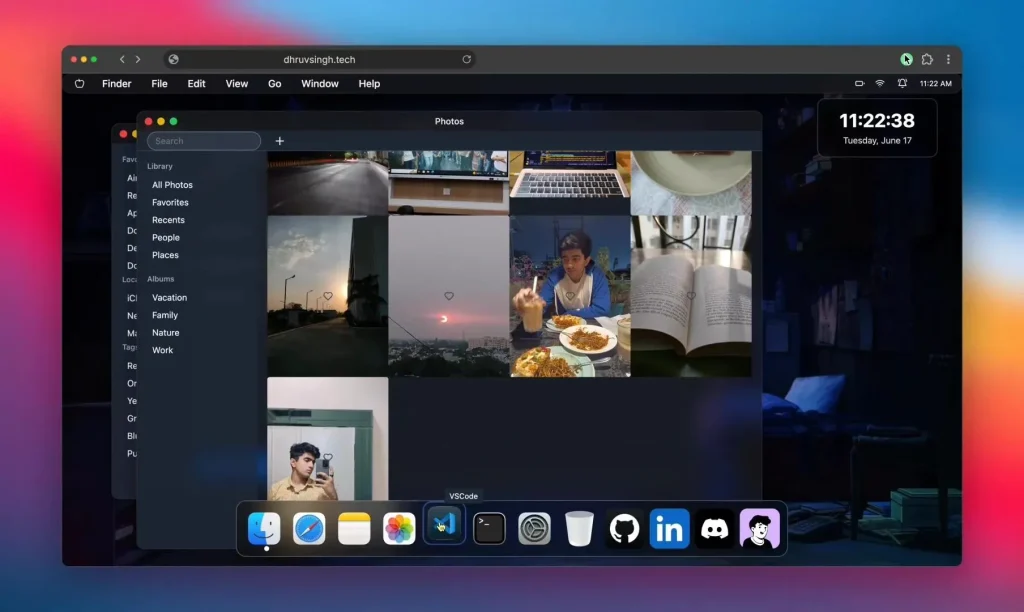
After the process finished, the creator shared the completed interface online, where it quickly gained attention from developers, designers, and AI researchers.
Important clarification
Although the interface looked similar to Apple’s operating system, it was not the actual macOS software.
The project was a web application that simulates the appearance and behavior of macOS inside a browser. It does not contain Apple’s operating system kernel, system services, or native macOS components.
This distinction is important because the AI recreated the user experience and visual design, not Apple’s proprietary operating system itself.
What Is Kimi K3?
Kimi K3 is the latest flagship large language model (LLM) developed by Moonshot AI, a Chinese artificial intelligence startup known for building advanced AI assistants and coding models. The model is designed to handle complex reasoning, software development, and long-running agent-based tasks, making it one of the company’s most capable AI releases to date.
Unlike traditional AI chatbots that primarily answer questions or generate short pieces of code, Kimi K3 is built to work on large, multi-step projects. It can understand lengthy instructions, divide a task into smaller objectives, generate code across multiple files, debug problems, and combine everything into a functional application. This makes it particularly useful for developers building web applications, user interfaces, automation tools, and other software projects.
Key Highlights of Kimi K3
- Developer: Moonshot AI (China)
- Model Type: Large Language Model (LLM)
- Primary Strengths: Coding, reasoning, software development, and AI agents
- Context Window: Up to 1 million tokens, allowing it to process extremely large documents and codebases
- Agent Swarm: Multiple AI agents can collaborate on different parts of the same project
- Best For: Web development, frontend design, debugging, code generation, research, and long-form tasks
Kimi K3 at a Glance
| Feature | Details |
|---|---|
| Developer | Moonshot AI |
| Release | 2026 |
| AI Type | Large Language Model (LLM) |
| Maximum Context Window | Up to 1 million tokens |
| Agent System | Agent Swarm with multiple collaborative AI agents |
| Main Capabilities | Coding, reasoning, planning, debugging, research |
| Target Users | Developers, businesses, researchers, and AI enthusiasts |
Core Capabilities
Kimi K3 combines several advanced AI capabilities into a single model, enabling it to perform tasks that previously required multiple tools or extensive manual effort.
| Capability | How It Helps Users |
|---|---|
| Code Generation | Creates applications, scripts, and software from natural language prompts. |
| Multi-Step Planning | Breaks large projects into manageable tasks before writing code. |
| Long Context Understanding | Processes lengthy documents, technical manuals, and large code repositories. |
| Debugging | Identifies and fixes coding errors during development. |
| Frontend Development | Builds modern websites and interactive user interfaces. |
| Agent Collaboration | Multiple AI agents work together on planning, coding, testing, and refinement. |
What Makes Kimi K3 Different?
One of Kimi K3’s standout features is its Agent Swarm architecture. Instead of relying on a single AI model to complete every task sequentially, Kimi K3 can assign different responsibilities to multiple AI agents working in parallel. For example, one agent may plan the project structure, another writes backend logic, a third develops the user interface, while another reviews and debugs the generated code.
This collaborative approach enables Kimi K3 to tackle larger and more complex software projects more efficiently than many conventional AI coding assistants.
Typical Use Cases
Kimi K3 can be applied across a wide range of professional and technical tasks, including:
- Building complete web applications from a single prompt.
- Creating interactive user interfaces and dashboards.
- Developing prototypes for startups and businesses.
- Debugging and improving existing codebases.
- Generating technical documentation and reports.
- Automating repetitive programming tasks.
- Assisting with research and long-form content analysis.
With its large context window, autonomous workflow capabilities, and strong coding performance, Kimi K3 represents the growing shift toward AI systems that can act as collaborative software development partners rather than simple code-generation tools.
Why the Demo Matters?
Traditionally, AI coding assistants generated individual snippets of code that developers had to assemble manually. The Kimi K3 demonstration suggests that newer AI systems can increasingly:
- Interpret a high-level request
- Plan the software architecture
- Generate multiple components
- Debug errors
- Integrate features
- Deliver a complete working project
This represents a significant shift from code completion to end-to-end software creation.
Benchmark Performance
Kimi K3 has also drawn attention for its coding benchmark results. Reports from AI evaluation platforms indicate that the model performed strongly in frontend development tests, achieving a high win rate when compared with other leading AI coding models on similar tasks.
While benchmark scores do not guarantee real-world performance, they provide an indication that the model is particularly effective at generating user interfaces and web applications.
How Kimi K3 Differs From Traditional AI Coding Tools
| Traditional AI Assistant | Kimi K3 Approach |
|---|---|
| Generates code snippets | Builds complete projects |
| Handles one task at a time | Uses multiple agents simultaneously |
| Limited context memory | Up to 1 million tokens of context |
| Requires frequent user guidance | Can execute long multi-step workflows |
| Focus on assistance | Focus on autonomous project execution |
Practical Implications for Developers
The Kimi K3 demonstration highlights how AI-assisted software development is evolving from simple code suggestions to building complete applications. While developers are unlikely to be replaced by AI anytime soon, tools like Kimi K3 can significantly improve productivity by handling repetitive coding tasks, generating project structures, and accelerating development workflows. This allows developers to spend more time on system design, security, performance optimization, and solving complex business problems.
For startups, freelancers, and enterprise teams, Kimi K3 could reduce the time required to build prototypes, test new ideas, and create internal tools. However, AI-generated applications still require careful human review to ensure code quality, security, maintainability, and compliance with industry standards.
How Developers Can Benefit
- Faster prototyping: Build proof-of-concept applications in hours instead of days or weeks.
- Improved productivity: Automate repetitive coding, documentation, and debugging tasks.
- Better collaboration: Quickly generate boilerplate code, APIs, and UI components that teams can refine together.
- Learning support: Junior developers can use AI-generated examples to understand coding patterns and best practices.
- Rapid experimentation: Test new frameworks, designs, or features with minimal manual effort.
Benefits and Challenges
| Benefits | Challenges |
|---|---|
| Faster software development | AI-generated code still needs human review |
| Reduces repetitive programming tasks | Large projects can consume significant computing resources |
| Helps build complete application prototypes | Potential security or performance issues must be checked |
| Supports developers with planning and debugging | Generated code may require optimization and refactoring |
| Speeds up frontend and full-stack development | AI may misunderstand complex business requirements |
Best Practices When Using Kimi K3
To get the best results, developers should use Kimi K3 as a collaborative assistant rather than relying on it to produce production-ready software without supervision.
- Start with a clear and detailed prompt that explains the application’s goals and features.
- Review all generated code for accuracy, security, and maintainability.
- Test the application thoroughly before deployment.
- Use version control to track AI-generated changes.
- Refine and optimize the generated code to meet project standards and performance requirements.
As AI coding models continue to improve, developers who learn to work effectively with these tools are likely to gain a significant productivity advantage while maintaining the critical human oversight needed to build reliable, secure, and scalable software.
What Kimi K3 Still Cannot Do?
Despite its impressive capabilities, Kimi K3 is not a fully autonomous software engineer. The macOS-style demonstration showcased what modern AI can achieve, but it also highlighted several practical limitations that developers and businesses should keep in mind. Like other advanced AI models, Kimi K3 performs best when working alongside human expertise rather than replacing it entirely.
While the model can generate large amounts of code, plan projects, and automate many development tasks, it still depends on human oversight to ensure the final software is accurate, secure, efficient, and aligned with real-world requirements.
Current Limitations of Kimi K3
| Limitation | Why It Matters |
|---|---|
| Cannot build the real macOS | It can recreate the look and feel of macOS but cannot generate Apple’s proprietary operating system or kernel. |
| Requires human review | AI-generated code should always be tested for quality, security, and maintainability. |
| May produce coding errors | Bugs, logic mistakes, or inefficient code can still occur in complex projects. |
| High computing requirements | Long-running tasks consume significant processing power and AI usage credits. |
| Limited understanding of business context | It may not fully understand unique business goals without detailed instructions. |
| Cannot make independent business decisions | Human developers must decide architecture, priorities, and product direction. |
Challenges Developers Should Consider
Although Kimi K3 can automate many development tasks, developers should remain involved throughout the software development process.
- Code validation: Every generated application should be reviewed and tested before production deployment.
- Security checks: AI cannot guarantee protection against vulnerabilities or compliance with security best practices.
- Performance optimization: Generated code may work correctly but still require optimization for speed, scalability, and resource usage.
- Maintenance: Long-term software maintenance, updates, and architectural improvements still require experienced developers.
- Legal and licensing considerations: Developers should verify that generated code complies with licensing requirements and organizational policies.
Human Expertise Remains Essential
Kimi K3 can significantly reduce development time, but it cannot replace critical human judgment. Experienced developers are still needed to:
- Design scalable software architectures.
- Protect sensitive user data and implement security best practices.
- Review AI-generated code for accuracy and efficiency.
- Conduct thorough testing and quality assurance.
- Ensure applications meet business, legal, and regulatory requirements.
- Make strategic product and engineering decisions.
Looking Ahead
AI coding models like Kimi K3 are improving rapidly, but they are best viewed as powerful development assistants rather than complete replacements for software engineers. As the technology matures, these models will likely automate more routine programming tasks, while developers continue to focus on creativity, problem-solving, system design, and delivering reliable, secure, and user-focused software.
Why the AI Industry Is Paying Attention?
The Kimi K3 macOS-style project has fueled discussion about how quickly AI coding systems are advancing. The most notable aspect is not that the AI produced a desktop-like interface, but that it was able to plan, generate, and assemble an entire software experience from a single instruction.
As AI models become better at handling long-running tasks, the line between a coding assistant and an autonomous software agent continues to blur.
What This Means for the Future?
The Kimi K3 demonstration suggests that the next generation of AI development tools will focus less on helping users write individual lines of code and more on delivering complete working applications.
For businesses, this could accelerate software prototyping and internal tool development. For developers, it may shift the emphasis toward architecture, validation, security, and product design rather than routine code generation.
However, the experiment also shows that powerful AI coding systems still require significant computing resources and human oversight. The technology is advancing rapidly, but it has not yet reached the point where complex software can be created entirely without expert review.
The Kimi K3 macOS-style demo is therefore best viewed as a glimpse of where AI-assisted software development is heading: toward more autonomous, project-level capabilities that can transform a simple prompt into a functioning application.
Frequently Asked Questions
Did Kimi K3 build the real macOS?
No. It created a browser-based web application that looks and behaves similarly to macOS, but it does not contain Apple’s operating system software.
How long did the project take?
Public reports indicate the AI spent roughly three hours and twenty minutes generating and assembling the application.
Can Kimi K3 write code automatically?
Yes. The model is designed for autonomous coding workflows and can plan, write, debug, and integrate code across multiple components.
What makes Kimi K3 different?
Its large context window and Agent Swarm system allow multiple AI agents to work on different parts of a project simultaneously.
Could this replace software developers?
Not currently. AI can accelerate development, but human expertise is still needed for architecture, security, testing, compliance, and long-term maintenance.
Final Thoughts
Kimi K3’s ability to create a functional macOS-style web application from a single prompt marks another important step in the rapid evolution of AI-powered software development. Rather than simply generating code snippets, the model demonstrated how modern AI can plan, build, and assemble an entire application with minimal human input. While the project required several hours to complete and consumed significant computing resources, it highlights how quickly AI coding capabilities are advancing.
Although the demonstration does not mean AI can replace professional software developers, it shows that intelligent coding assistants are becoming far more capable than ever before. As models like Kimi K3 continue to improve, we can expect faster prototyping, more automated development workflows, and new opportunities for businesses and developers alike. The coming years will likely see AI playing an even larger role in software creation, with human expertise remaining essential for oversight, security, and delivering high-quality applications.
Also read: Kimi K3 Launch: World’s Largest Open AI Model Explained


