
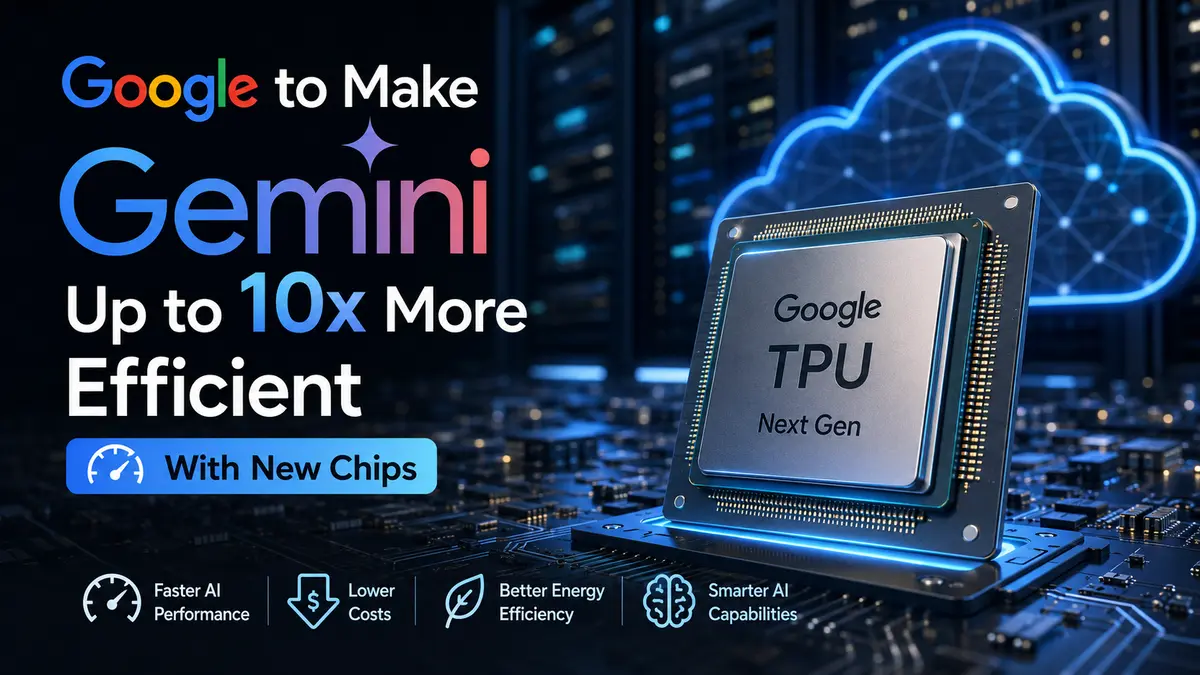
Google to Make Gemini 10x More Efficient With New Chips
Google is preparing a new generation of artificial intelligence chips that could make Gemini up to 10 times more efficient than before. The company aims to reduce AI operating costs, improve response speed, and support increasingly advanced AI models. If successful, these custom chips could strengthen Google’s position in the rapidly growing AI industry while making Gemini faster, cheaper, and more widely available.
Artificial intelligence has become one of the biggest technology battlegrounds in recent years. Companies such as Google, OpenAI, Microsoft, Meta, Amazon, and Anthropic are investing billions of dollars into new AI infrastructure to build smarter models and deliver better services. However, training and running these models requires enormous computing power, leading to rising costs and energy consumption.
Google’s latest strategy focuses on solving that challenge through more powerful and efficient AI chips designed specifically for Gemini. Rather than relying entirely on third-party hardware, Google continues expanding its own Tensor Processing Unit (TPU) lineup, allowing it to optimize hardware and software together.
The announcement signals another major step in Google’s long-term AI roadmap and could reshape how large language models are developed and deployed over the coming years.
Google’s Next AI Milestone
Google has spent years developing custom AI hardware behind the scenes. While NVIDIA currently dominates the AI chip market with its GPUs, Google has quietly built several generations of TPUs that power many of its internal AI products.
The newest generation is expected to deliver dramatic improvements in several critical areas:
- Up to 10x better efficiency for Gemini workloads
- Lower computing costs
- Faster AI inference
- Better performance per watt
- Higher scalability for future AI models
- Improved support for enterprise AI applications
Instead of simply making chips faster, Google appears focused on making every watt of electricity and every dollar spent on computing produce significantly more AI output.
This approach becomes increasingly important as AI models continue growing larger and more expensive.
Why AI Chips Matter More Than Ever?
Artificial intelligence is no longer limited to research laboratories.
Today, AI powers:
| Industry | AI Applications |
|---|---|
| Search | Smarter search results |
| Healthcare | Medical research and diagnosis |
| Education | AI tutoring systems |
| Finance | Fraud detection and analysis |
| Customer Service | AI chatbots |
| Software Development | Code generation |
| Marketing | Content creation |
| Manufacturing | Automation and quality control |
Every one of these applications depends on enormous computing infrastructure.
Training a modern frontier AI model can require tens of thousands of advanced processors running continuously for weeks or even months. After deployment, millions of users interact with these models every day, creating another layer of computing demand known as inference.
Reducing the cost of inference has become one of the industry’s biggest priorities because it directly affects how affordable AI services can become.
Google’s latest chip development targets exactly this challenge.
Understanding Google’s Tensor Processing Units (TPUs)
Unlike general-purpose graphics cards, Google’s Tensor Processing Units are custom-built specifically for machine learning.
The company first introduced TPUs nearly a decade ago to accelerate AI workloads inside Google’s data centers. Since then, every new generation has significantly improved speed, memory bandwidth, and energy efficiency.
Some major advantages of TPUs include:
- Specialized architecture for neural networks
- High-speed matrix calculations
- Lower latency
- Reduced power consumption
- Better integration with Google’s AI software stack
- Large-scale deployment across Google Cloud
Because Gemini was designed alongside Google’s hardware ecosystem, TPUs can often execute AI workloads more efficiently than generic processors.
This hardware-software integration gives Google greater control over performance optimization.
What Does “10x More Efficient” Actually Mean?
The phrase “10x more efficient” does not necessarily mean Gemini becomes ten times smarter.
Instead, efficiency generally refers to how effectively computing resources are used.
That improvement can include several areas.
Lower Computing Costs
Running large AI models is extremely expensive.
Every question submitted to an AI assistant requires computing resources inside massive data centers.
If Google’s new chips reduce hardware requirements by even a fraction, the savings across billions of AI requests become enormous.
A tenfold efficiency improvement could potentially allow Google to:
- Serve more users simultaneously
- Lower infrastructure expenses
- Reduce cloud operating costs
- Expand AI availability
These savings could eventually benefit businesses using Gemini through Google Cloud and may also improve consumer services.
Faster AI Responses
Efficiency improvements often reduce latency.
Users may notice:
- Faster answers
- Quicker image generation
- Improved voice conversations
- More responsive coding assistance
- Better real-time AI interactions
As AI becomes integrated into search engines, productivity tools, Android devices, and enterprise software, response time becomes increasingly important.
Better Energy Efficiency
Modern AI data centers consume enormous amounts of electricity.
One of the largest challenges facing the AI industry is balancing rapid innovation with sustainable infrastructure.
More efficient chips can:
- Consume less electricity
- Produce less heat
- Reduce cooling requirements
- Lower operational expenses
- Improve environmental sustainability
This becomes increasingly valuable as AI demand continues growing worldwide.
Why Google Is Investing So Heavily in Custom AI Chips?
The AI race is no longer only about building better language models.
It has become equally important to build better infrastructure.
Google’s strategy offers several competitive advantages.
Reducing Dependence on External Suppliers
NVIDIA currently supplies much of the world’s AI hardware.
Demand has grown so rapidly that advanced GPUs often experience supply shortages.
By designing its own processors, Google gains greater control over:
- Hardware availability
- Product roadmap
- Manufacturing planning
- Long-term AI development
This reduces reliance on external suppliers while allowing Google to optimize chips specifically for Gemini.
Lower Long-Term Costs
Although designing custom processors requires billions of dollars in investment, they can substantially reduce long-term operating expenses.
Google runs one of the world’s largest cloud infrastructures.
Even small efficiency improvements across millions of servers translate into enormous financial savings.
If the new chips truly approach the reported efficiency improvements, they could significantly improve Google’s AI economics over the coming years.
Stronger Integration Across Google’s Ecosystem
Google controls nearly every layer of its AI platform.
These include:
- Gemini models
- Google Search
- Google Cloud
- Android
- Workspace
- Chrome
- TPUs
- AI software frameworks
Because all these components are developed within Google’s ecosystem, engineers can optimize performance more effectively than companies relying on separate hardware vendors.
This vertical integration has become one of Google’s biggest strengths in AI infrastructure.
How These New Chips Could Improve Gemini?
Gemini has rapidly evolved from a chatbot into Google’s central AI platform.
Today it powers features across numerous Google products.
Potential improvements enabled by more efficient chips include:
Longer Context Windows
Future Gemini models may process significantly larger documents, books, reports, and conversations without sacrificing performance.
This would make Gemini more useful for researchers, businesses, students, and developers.
Better Multimodal AI
Gemini already supports:
- Text
- Images
- Audio
- Video
- Documents
- Code
More efficient hardware could accelerate multimodal processing, allowing the model to understand several types of content simultaneously with lower latency.
More Advanced Reasoning
Complex reasoning tasks often require more computation than simple question answering.
Improved chip efficiency could enable Gemini to spend additional computing resources on reasoning while maintaining fast responses.
This may lead to stronger performance in areas such as:
- Scientific research
- Software engineering
- Mathematics
- Data analysis
- Business planning
- Technical documentation
Expanded Enterprise Capabilities
Businesses increasingly deploy Gemini through Google Cloud.
Lower operating costs could encourage organizations to adopt AI for:
- Customer support
- Internal knowledge management
- Document analysis
- Software development
- Workflow automation
- Business intelligence
Enterprise customers often prioritize cost efficiency as much as model quality, making improved hardware a significant competitive advantage.
What This Means for Google Cloud Customers?
Google Cloud has become one of the company’s fastest-growing businesses, with AI serving as a major growth driver.
Custom AI chips could provide cloud customers with several practical benefits.
| Potential Benefit | Business Impact |
|---|---|
| Lower AI inference costs | Reduced operating expenses |
| Faster response times | Better customer experiences |
| Improved scalability | Handle larger workloads |
| Better resource efficiency | Higher productivity |
| Advanced AI capabilities | More sophisticated applications |
Organizations building AI-powered products increasingly evaluate cloud providers based not only on model performance but also on infrastructure efficiency.
Google’s investment in custom TPUs could therefore strengthen its competitive position against other major cloud providers.
How This Fits Into the Global AI Competition?
The competition among technology giants has shifted beyond creating the smartest AI model. Today, success increasingly depends on who can build the most efficient infrastructure to train and run those models at scale.
Google’s reported push toward chips capable of making Gemini up to 10 times more efficient reflects this broader industry trend. Instead of relying solely on increasingly expensive hardware, leading companies are investing in custom silicon designed specifically for artificial intelligence.
As AI adoption accelerates across businesses and consumer products, infrastructure efficiency may become just as important as model intelligence itself.
Google vs Other AI Giants: The Hardware Race Intensifies
Google is not the only technology company investing heavily in custom AI hardware. Nearly every major AI player is developing specialized chips to reduce costs, improve performance, and gain greater control over its infrastructure.
Here’s how some of the biggest companies compare:
| Company | AI Model | AI Hardware Strategy |
|---|---|---|
| Gemini | Custom Tensor Processing Units (TPUs) | |
| OpenAI | GPT Series | Primarily NVIDIA GPUs, with custom chip efforts reported |
| Microsoft | Copilot | Azure Maia AI accelerators alongside NVIDIA GPUs |
| Meta | Llama | Meta Training and Inference Accelerator (MTIA) |
| Amazon | Nova AI Models | AWS Trainium and Inferentia chips |
| NVIDIA | AI Hardware | Supplies GPUs to most AI companies worldwide |
Unlike NVIDIA, which sells hardware to many customers, Google designs TPUs primarily for its own services and Google Cloud. This allows Google to tailor every layer of its AI stack—from hardware to software—for maximum efficiency.
Why Efficiency Matters More Than Raw Performance?
When people hear about new AI chips, they often assume the goal is simply to make AI faster. In reality, efficiency is becoming just as important as peak performance.
Large AI systems serve millions of users every day. Even a small improvement in efficiency can translate into:
- Millions of dollars in annual savings
- Lower electricity consumption
- Reduced cooling requirements
- Smaller environmental impact
- Greater availability of AI services
- Better profit margins for cloud providers
For example, if a data center can process significantly more AI requests using the same amount of electricity, the overall cost per request drops dramatically.
This makes AI services more affordable for developers, businesses, and consumers.
Could This Reduce the Cost of AI Services?
One of the biggest questions surrounding Google’s announcement is whether these efficiency gains will eventually reduce AI costs for customers.
While Google has not announced any pricing changes, lower infrastructure costs could create several possibilities over time:
For Individual Users
- Faster Gemini responses
- More advanced free AI features
- Improved AI experiences across Google products
- Better real-time voice assistants
For Businesses
- Lower API costs
- Reduced cloud AI expenses
- More scalable enterprise deployments
- Greater return on AI investments
For Developers
Developers building applications on Google Cloud could benefit from:
- Lower inference costs
- Higher request capacity
- Faster model execution
- Better performance for AI-powered applications
Although pricing decisions depend on many factors, improved infrastructure efficiency gives Google greater flexibility in how it offers AI services.
The Technical Challenges Google Still Faces
Developing cutting-edge AI chips is one of the most difficult engineering tasks in the technology industry.
Even with Google’s extensive experience, several challenges remain.
Manufacturing Complexity
Modern AI processors contain billions of transistors packed into extremely small spaces.
Manufacturing these chips requires advanced semiconductor fabrication processes, specialized packaging technologies, and strong partnerships with leading chip manufacturers.
Any production delays could affect deployment timelines.
Growing AI Model Sizes
AI models continue becoming larger and more capable.
Each new generation typically demands:
- More memory
- Greater bandwidth
- Faster communication between processors
- Increased storage capacity
- More efficient cooling
As models grow, hardware improvements must keep pace.
Software Optimization
Powerful hardware alone is not enough.
Google must also optimize:
- Gemini architecture
- AI frameworks
- Data center networking
- Memory management
- Compiler technology
The greatest efficiency gains often come from optimizing hardware and software together.
Also read: Best AI Tools for Students in 2026 | Complete Guide
What This Means for Everyday Google Users?
Many people may never see Google’s new chips directly, but they are likely to experience the benefits through the products they already use.
Potential improvements include:
Google Search
AI-generated search results could become:
- Faster
- More detailed
- More accurate
- Better able to handle complex queries
Android
Gemini-powered features on Android devices may benefit from:
- Improved voice interactions
- Faster on-device assistance
- Better AI recommendations
- More responsive productivity tools
Google Workspace
Applications such as Docs, Gmail, Sheets, and Slides could offer:
- Faster writing assistance
- Smarter document summaries
- Better meeting notes
- More advanced automation
Developers
Software developers may experience:
- Improved code generation
- Faster debugging
- Better reasoning capabilities
- Enhanced AI coding assistants
As Google’s infrastructure improves, these benefits could gradually appear across many of its products.
Environmental Impact: Why Efficient Chips Matter?
Artificial intelligence is transforming industries, but it also raises concerns about energy consumption.
Large AI data centers require:
- Massive electricity supplies
- Advanced cooling systems
- Continuous operation
- Significant infrastructure investments
Improving efficiency helps address these challenges.
Potential environmental benefits include:
- Lower electricity usage per AI request
- Reduced carbon emissions
- Less heat generation
- Better utilization of existing data centers
- Improved long-term sustainability
While AI demand will likely continue growing, more efficient hardware can help reduce the environmental cost of delivering increasingly powerful AI services.
Industry Experts Expect Infrastructure to Become the Next Competitive Advantage
For the past few years, headlines have focused on which company has the smartest AI model.
Increasingly, however, analysts believe the next phase of competition will center on infrastructure.
The reasons are straightforward:
- AI models continue growing in size.
- Computing costs remain extremely high.
- Demand for AI services is increasing rapidly.
- Businesses expect faster and more affordable AI.
Companies that successfully reduce operating costs while maintaining strong performance are likely to gain an important competitive advantage.
Google’s continued investment in custom TPUs reflects this shift in strategy.
Rather than competing only on model intelligence, the company is also competing on the efficiency and scalability of the systems that power those models.
What to Watch Next?
Although Google has shared its direction, several important developments will determine how successful this initiative becomes.
Key areas to watch include:
- Performance Benchmarks: Independent tests will reveal how much faster and more efficient the new chips are in real-world AI workloads.
- Gemini Model Updates: Future versions of Gemini may introduce capabilities that take full advantage of the upgraded hardware.
- Google Cloud Availability: Businesses will be watching closely to see when these chips become widely available through Google Cloud services.
- Enterprise Adoption: If organizations see lower costs and better performance, adoption of Gemini-powered enterprise solutions could accelerate.
- Competitor Responses: Companies such as Microsoft, Amazon, Meta, and NVIDIA are expected to continue advancing their own AI hardware, ensuring that the competition remains intense.
Key Takeaways
Google’s latest effort to make Gemini up to 10 times more efficient with new AI chips highlights an important shift in the artificial intelligence industry. The race is no longer focused solely on creating more capable language models—it is also about building the infrastructure that can run them efficiently, economically, and at massive scale.
If Google’s next-generation TPUs deliver the expected improvements, the benefits could extend well beyond the company itself. Faster responses, lower operating costs, improved energy efficiency, and more powerful AI features would help consumers, developers, and businesses alike.
While real-world benchmarks and deployment timelines will ultimately determine the full impact, Google’s investment demonstrates that custom AI hardware has become a strategic advantage in the global AI race. As demand for artificial intelligence continues to grow, efficient chips will play an increasingly central role in shaping the future of AI services.
Also read: Best AI Apps for Everyday Life: Top 10 AI Tools in 2026
Frequently Asked Questions (FAQs)
1. What does “Google to Make Gemini Up to 10x More Efficient With New Chips” mean?
It means Google is developing new AI chips designed to significantly improve how efficiently Gemini runs. The reported improvement relates to computing efficiency, which can reduce costs, improve speed, and lower energy consumption rather than making the model ten times smarter.
2. Will Gemini become faster with the new chips?
Potentially, yes. More efficient hardware can reduce latency, allowing Gemini to generate responses more quickly, process larger workloads, and deliver smoother experiences across Google products and services.
3. Are these chips replacing NVIDIA GPUs?
Not entirely. Google already uses its custom Tensor Processing Units (TPUs) for many AI workloads, while also relying on NVIDIA hardware in certain situations. The new chips are expected to expand Google’s in-house AI infrastructure rather than completely replace third-party processors.
4. How could businesses benefit from these improvements?
Businesses using Google Cloud may benefit from lower AI infrastructure costs, improved scalability, faster AI inference, and better performance for enterprise applications such as customer support, software development, document analysis, and workflow automation.
5. Will ordinary users notice any changes?
Most users will not interact with the chips directly, but they could notice improvements through faster Gemini responses, smarter AI-powered features in Google Search, Android, Gmail, Docs, and other Google services.
6. Why are custom AI chips becoming so important?
Training and running advanced AI models require enormous computing resources. Custom chips help companies optimize performance, reduce operating expenses, improve energy efficiency, and maintain greater control over their AI infrastructure.
7. When will Google’s new AI chips be available?
Google has outlined its plans for more efficient AI hardware, but a complete public rollout timeline has not yet been announced. Availability is expected to expand gradually across Google’s data centers and Google Cloud infrastructure.
8. Could these chips help Google compete more effectively in AI?
Yes. By combining powerful Gemini models with highly optimized custom TPUs, Google can improve performance, lower operating costs, and strengthen its position against competitors such as OpenAI, Microsoft, Meta, Amazon, and NVIDIA.
Conclusion
Google’s plan to make Gemini up to 10x more efficient with new chips marks an important milestone in the evolution of artificial intelligence. As AI models become larger and more widely used, improving efficiency is just as important as improving raw performance. Google’s investment in next-generation Tensor Processing Units (TPUs) shows that the company is focused on reducing costs, increasing speed, and delivering more powerful AI experiences without dramatically increasing computing resources.
Although the full impact of these new chips will become clearer once they are deployed at scale, the direction is evident. More efficient AI hardware could help Google expand Gemini across Search, Workspace, Android, and Google Cloud while making advanced AI services faster, more affordable, and more sustainable. As competition in the AI industry continues to intensify, Google’s custom chip strategy could become one of its biggest competitive advantages, shaping not only the future of Gemini but also the broader AI ecosystem for years to come.
Also read: Kimi K3 Launch: World’s Largest Open AI Model Explained


