
Google Play Store New Billing Rules and Lower Fees
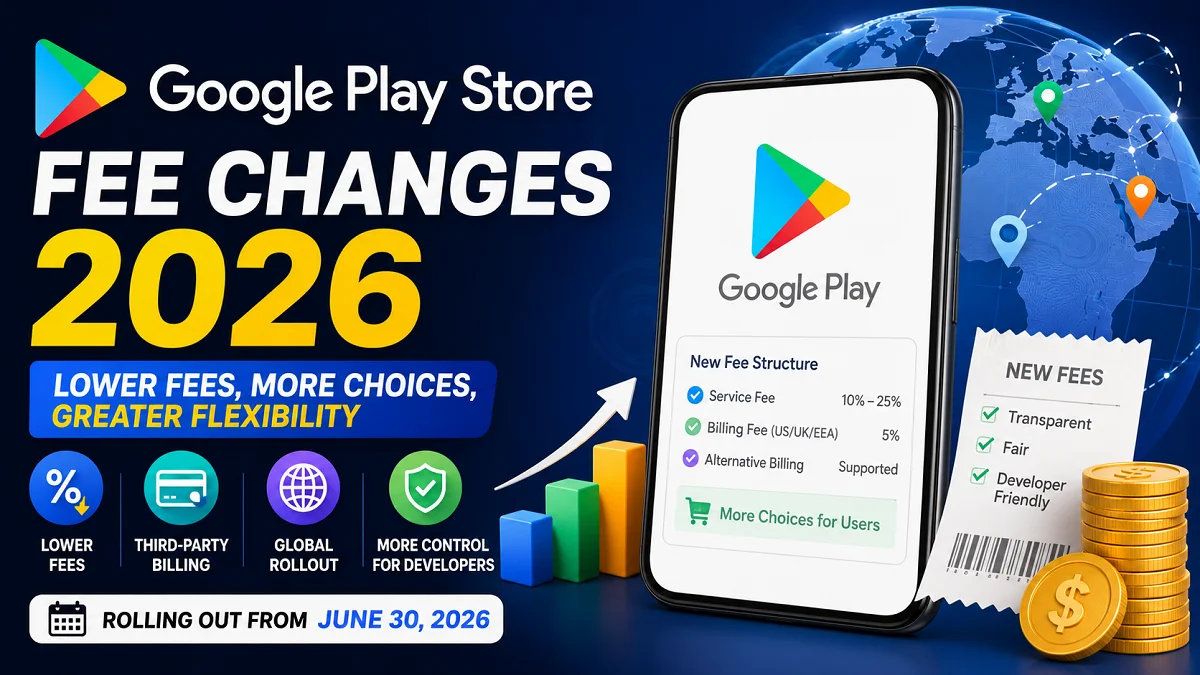
Google Play Store New Billing Rules: Google has announced one of the biggest changes to the Play Store in recent years. The company is introducing a new fee structure, allowing developers to use third-party payment systems, and reducing service fees for many app developers.
These updates are designed to give developers greater flexibility while addressing long-standing concerns about Play Store commissions. Although the rollout starts in selected countries, Google plans to expand the new system worldwide over the coming months.
Why Is Google Changing the Play Store Fee Structure?
For years, developers have argued that app store commissions were too high and limited their payment choices.
Several factors encouraged Google to update its policies:
- Increased regulatory pressure in different countries
- Growing competition among app marketplaces
- Requests from developers for lower fees
- Court rulings and antitrust investigations
- Demand for greater payment flexibility
Instead of charging one combined commission, Google will now separate:
- Service fees
- Billing processing fees
This makes it easier for developers to understand exactly what they are paying for.
What Is the New Google Play Store Fee Structure?
Previously, developers generally paid a single commission that covered both Play Store services and payment processing.
Under the new model, these charges are separated.
Service Fee
The service fee covers benefits such as:
- App discovery
- Play Store hosting
- Security reviews
- Malware protection
- Developer tools
- Software updates
- Distribution infrastructure
- Customer trust and safety systems
Developers continue paying this fee even if they use another payment provider.
Billing Fee
The billing fee only applies when developers use Google Play Billing.
It covers:
- Payment processing
- Refund handling
- Fraud prevention
- Transaction management
- Payment security
If a developer uses an alternative payment provider, this billing fee is removed.
New Google Play Store Service Fees
The updated service fee depends on both annual earnings and the type of transaction.
| Transaction Type | First $1 Million Revenue | Above $1 Million |
|---|---|---|
| Auto-renewing subscriptions | 10% | 10% |
| Other purchases (new installs) | 10% | 20% |
| Other purchases (existing installs) | 10% | 25% |
| External website purchases | 10% | 20% |
What Is the 5% Billing Fee?
In the first rollout markets, Google Play Billing adds a separate 5% billing fee.
For example:
| Service Fee | Billing Fee | Total Fee |
|---|---|---|
| 10% | 5% | 15% |
| 20% | 5% | 25% |
| 25% | 5% | 30% |
Developers who switch to an alternative payment processor avoid paying this extra 5% billing fee.
Google Now Allows Third-Party Billing
One of the biggest announcements is that developers can now offer payment methods outside Google Play Billing.
Developers may:
- Accept payments through their own payment providers
- Offer multiple payment choices
- Direct customers to their own websites
- Reduce payment processing costs
- Improve flexibility for subscriptions and digital purchases
This is a significant policy change because Google Play previously required most digital purchases to use its own billing system.
How Alternative Billing Works
The process is fairly straightforward.
Step 1: Join the Program
Developers must enroll through the Google Play Console.
Step 2: Integrate Google’s APIs
Required billing APIs must be added to the application.
Step 3: Offer Payment Options
Developers can:
- Use Google Play Billing
- Offer third-party billing
- Provide both options
Step 4: Report Transactions
Sales completed outside Google Play must still be reported to Google.
Step 5: Pay Applicable Service Fees
Only the billing fee is removed when using an external payment provider.
What Counts as a New Install?
The fee charged above the first $1 million depends partly on whether an app installation is considered “new.”
A new install means:
- The app is first installed after the new fee system launches in that market, or
- The user updates the app for the first time after the launch date, as defined by Google’s policy.
Older installs are treated as existing installs and may be subject to different service fee rates.
Existing Installs vs New Installs
| Feature | New Install | Existing Install |
|---|---|---|
| Installed after rollout | Yes | No |
| Higher service fee after $1M | 20% | 25% |
| External website purchase fee | 20% | 20% |
Understanding this distinction is important for developers forecasting future revenue.
Lower Fees Through Google’s New Developer Programs
Google has also updated two incentive programs:
- Games Level Up
- Apps Experience Program
Qualified developers can receive additional fee reductions.
Reduced Service Fees
| Transaction Type | Reduced Fee |
|---|---|
| Auto-renew subscriptions | 10% |
| Other purchases (new installs) | 15% |
| Other purchases (existing installs) | 20% |
| External website purchases | 15% |
These lower rates become available beginning September 30, 2026 in eligible markets.
Benefits for App Developers
Many developers could benefit from these changes.
Some key advantages include:
- Lower payment costs
- Greater control over customer payments
- Freedom to choose payment providers
- Better subscription flexibility
- Improved pricing strategies
- Opportunity to increase profits
- More transparency in fee calculations
Small businesses and independent developers may find the new model especially helpful.
What Do These Changes Mean for Users?
Most users will notice very little difference when downloading apps.
However, they may begin seeing:
- More payment choices
- Direct purchases through developer websites
- Different checkout experiences
- Competitive pricing on digital content
- More subscription options
Google has stated that developers must still meet security and user protection requirements, regardless of the payment method they use.
Will App Prices Become Cheaper?
Not necessarily.
Developers will decide whether to pass their savings on to customers.
Some companies may:
- Reduce subscription prices
- Offer discounts on their websites
- Provide bonus content for direct purchases
- Keep existing prices while improving profit margins
Pricing strategies will vary between developers.
Countries Included in the Rollout
Google is introducing the new system in phases.
| Region | Launch Date |
|---|---|
| United States | June 30, 2026 |
| United Kingdom | June 30, 2026 |
| European Economic Area | June 30, 2026 |
| Australia | September 30, 2026 |
| Japan | By December 31, 2026 |
| South Korea | By December 31, 2026 |
| Rest of the World | By September 30, 2027 |
Comparison: Old vs New Google Play Store Billing System
| Feature | Old System | New System |
|---|---|---|
| Billing choice | Mostly Google Play Billing | Multiple billing options |
| Separate billing fee | No | Yes |
| Alternative payment providers | Very limited | Supported |
| Website purchases | Restricted | Allowed |
| Fee transparency | Lower | Higher |
| Reduced developer programs | Limited | Expanded |
Frequently Asked Questions (FAQs)
Does Google still charge a service fee with third-party billing?
Yes. Developers continue paying the Play Store service fee. Only the separate Google Play Billing fee is removed when another payment provider is used.
Can developers completely avoid Google Play Store fees?
No. Apps distributed through the Play Store still pay the applicable service fee because Google continues providing hosting, security, discovery, and distribution services.
Will users be forced to use external payment methods?
No. Developers can offer Google Play Billing, third-party billing, or both, depending on the market and their business model.
Are subscriptions included in the new fee structure?
Yes. Auto-renewing subscriptions receive a 10% service fee, regardless of whether the developer earns more than $1 million annually.
Do developers need approval before using alternative billing?
Yes. Developers must enroll through Google Play Console, implement the required APIs, and comply with Google’s policies before offering alternative payment methods.
Final Thoughts (Google Play Store Fee)
Google Play Store changes represent one of the most significant updates to Android app distribution in years. By separating service fees from billing fees and allowing third-party payment systems, Google is giving developers greater flexibility while maintaining the core services that keep the Play Store secure and reliable.
For developers, these changes create opportunities to reduce payment processing costs, improve customer choice, and build more flexible business models. For users, the updates could eventually lead to more payment options and competitive pricing. As the rollout expands globally, developers should stay informed and prepare to take advantage of the new billing framework when it becomes available.
Also read: Most Downloaded Apps in the World: Complete 2026 Guide