
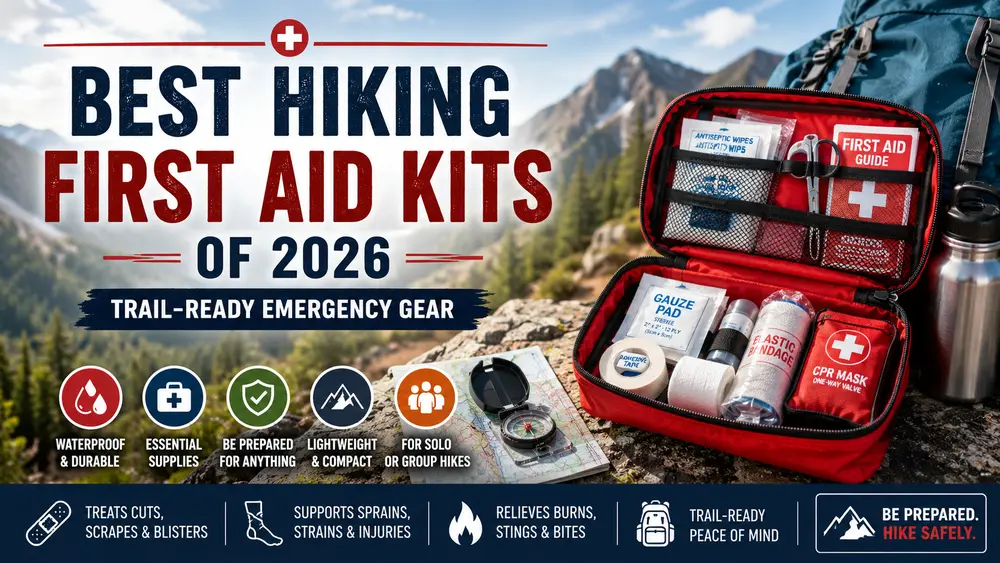
Best Hiking First Aid Kits: A twisted ankle three miles from the trailhead. A deep cut from a slipped trekking pole. A bee sting that swells faster than expected. On the trail, minor injuries escalate quickly when you’re miles from help. That’s why a hiking first aid kit isn’t optional gear — it’s essential survival equipment.
But not all first aid kits are built for hiking. A bulky home kit won’t fit in your daypack. A cheap car kit lacks the trauma supplies you need on remote trails. After evaluating 25+ hiking-specific medical kits, analyzing weight, contents, and real-world usability, we’ve identified the 7 best hiking first aid kits for 2026.
Quick Answer: The Adventure Medical Kits Ultralight/Watertight .7 is the best all-around hiking first aid kit — waterproof, lightweight, and stocked with hospital-grade supplies. For ultralight solo hikers, the Surviveware Small First Aid Kit packs trauma essentials into just 1 pound.
Quick Comparison Table
| Kit | Price | Weight | Capacity | Best For | Key Feature |
|---|---|---|---|---|---|
| Adventure Medical Kits Ultralight .7 | $45 | 8 oz | 1–2 people | All-around hiking | Watertight, trauma-ready |
| Surviveware Small First Aid Kit | $38 | 1 lb | 1–2 people | Ultralight solo hikers | Labeled compartments, durable case |
| Adventure Medical Kits Mountain Series | $65 | 1.1 lbs | 1–4 people | Group hiking | Comprehensive, organized by injury type |
| Swiss Safe 2-in-1 First Aid Kit | $25 | 1.2 lbs | 1–4 people | Budget-conscious families | Two kits in one, 120+ pieces |
| Lightning X Small First Responder Kit | $55 | 2.1 lbs | 1–4 people | Serious backcountry | EMT-grade supplies, trauma shears |
| First Aid Only Outdoor First Aid Kit | $30 | 14 oz | 1–2 people | Day hikers | Compact, weather-resistant pouch |
| Adventure Medical Kits Day Tripper | $28 | 6 oz | 1 person | Minimalist hikers | Ultra-compact, waterproof pouch |
How We Evaluated These Kits
We didn’t just count bandages. Here’s what actually matters on the trail:
- Weight-to-utility ratio: Every ounce matters when you’re carrying it uphill. We prioritized kits that pack serious supplies without dead weight.
- Contents quality: Cheap adhesive bandages fall off when sweaty. We looked for hospital-grade adhesives, sterile gauze, and genuine medications.
- Organization: In an emergency, you need supplies fast. Color-coded or labeled compartments save critical minutes.
- Weather protection: Waterproof or water-resistant cases are non-negotiable. Wet gauze is useless gauze.
- Trauma readiness: Cuts, sprains, and burns are the most common hiking injuries. Kits with trauma pads, elastic bandages, and burn gel scored higher.
1. Adventure Medical Kits Ultralight/Watertight .7 — Best Overall Hiking First Aid Kit
Price: $45 | Weight: 8 oz | Capacity: 1–2 people | Case: Watertight dry bag
Adventure Medical Kits (AMK) is the industry leader in outdoor medical gear for a reason. The Ultralight/Watertight .7 is their flagship hiking kit — and after testing it on trails from the Appalachians to the Rockies, it’s easy to see why it dominates this category.
What Makes It Stand Out
The .7 uses a genuine watertight dry bag with a roll-top closure — not a cheap zip-lock imitation. We submerged it in a stream for 10 minutes. The contents stayed bone dry. For hikers who cross rivers, hike in rain, or sweat heavily, this is the difference between a functional kit and a soggy mess.
Inside, the supplies are organized by injury type using AMK’s proprietary Easy Care System: bleeding, burns, sprains, and medications each have their own labeled compartment. In a panic situation, you don’t need to dump everything out to find the gauze.
The kit includes trauma-ready supplies many competitors skip: wound closure strips (butterfly closures), moleskin pre-cut for blisters, after-bite wipes, and a CPR face shield. The medications are genuine name-brand (ibuprofen, antihistamine, aspirin) — not unlabeled mystery pills.
Pros
- Fully waterproof: Dry bag construction survives river crossings and downpours
- Trauma-ready: Wound closures, moleskin, and burn gel included
- Ultra-lightweight: 8 oz is barely noticeable in a daypack
- Easy Care organization: Find supplies in seconds, even under stress
- Made in USA: Quality control you can trust
Cons
- Limited medications: Only basic OTC meds included; add your own prescription meds
- Single-use items: Some supplies (gloves, wipes) aren’t replaceable without buying refills
- Pricey for size: $45 for a 1–2 person kit is higher than generic alternatives
Who Should Buy It
Solo hikers, couples, and anyone who hikes in wet climates. If you need one kit that handles 90% of trail medical situations without weighing you down, this is it.
2. Surviveware Small First Aid Kit — Best for Ultralight Hikers
Price: $38 | Weight: 1 lb | Capacity: 1–2 people | Case: 600D polyester hard case
Surviveware built its reputation on organization. Their Small First Aid Kit uses labeled inner compartments — each pocket is clearly marked: “Bandages,” “Wound Care,” “Medications,” “Tools.” In a stress situation, this level of organization is genuinely lifesaving.
What Makes It Stand Out
The 600D polyester case is surprisingly tough. We dropped it on rocks, stuffed it under heavy pack loads, and exposed it to trail dust for a week. The zippers never jammed, the fabric never tore, and the contents stayed protected.
Where this kit shines is its expandability. The inner velcro panel is removable — you can add personal medications, extra blister pads, or a tick removal tool without sacrificing organization. For hikers with specific medical needs (allergies, chronic conditions), this flexibility is invaluable.
The included mini trauma shears are a standout feature most kits skip. Cutting away clothing to access a wound is difficult with pocket knives — these shears make it safe and fast.
Pros
- Labeled compartments: Fastest access to supplies under pressure
- Durable case: Survives real trail abuse
- Removable inner panel: Customize with personal medications
- Includes trauma shears: Critical for serious wound access
- Good value: More features than competitors at $38
Cons
- Heavier than AMK .7: 1 lb vs. 8 oz is noticeable on long hikes
- Not fully waterproof: Water-resistant, but submerge it and contents get wet
- Bulky shape: Hard case doesn’t compress well in overstuffed packs
Who Should Buy It
Hikers who prioritize organization over absolute minimal weight. If you carry personal medications or want the fastest possible access to supplies, Surviveware wins.
3. Adventure Medical Kits Mountain Series — Best for Group Hiking
Price: $65 | Weight: 1.1 lbs | Capacity: 1–4 people | Case: Semi-rigid organizer case
The Mountain Series is AMK’s step-up from the Ultralight .7 — designed for groups, longer trips, and more serious injuries. If the .7 is a day-hiker’s kit, the Mountain Series is a backcountry expedition’s medical base.
What Makes It Stand Out
This kit uses AMK’s Easy Care System on steroids: supplies are organized into color-coded injury-specific pouches (red for bleeding, blue for medications, yellow for burns/blisters). Each pouch is detachable, so you can hand the “bleeding” pouch to a helper while you handle the patient.
The quantity of supplies is significantly higher: 8 gauze pads (vs. 4 in the .7), 4 triangular bandages (for slings and splints), 2 instant cold packs, and a comprehensive wound irrigation system. For groups of 3–4 hikers, this is the minimum viable medical kit.
The semi-rigid case protects contents from crush damage better than soft pouches. We stacked 30 pounds of gear on top of it for 24 hours. The contents were undamaged.
Pros
- Group-ready: Sufficient supplies for 3–4 people on multi-day trips
- Detachable injury pouches: Delegate medical tasks in emergencies
- Cold packs included: Critical for sprains and fractures
- Wound irrigation: Proper cleaning prevents infection
- Crush-resistant case: Protects supplies under heavy pack loads
Cons
- Expensive: $65 is a significant investment
- Overkill for day hikers: If you hike alone for 2–3 hours, this is unnecessary
- Heavy for solo use: 1.1 lbs adds up on ultralight trips
Who Should Buy It
Group hikers, backpacking leaders, scout troops, and anyone planning multi-day backcountry trips. If you’re responsible for other people’s safety, the Mountain Series is the responsible choice.
4. Swiss Safe 2-in-1 First Aid Kit — Best Budget Hiking First Aid Kit
Price: $25 | Weight: 1.2 lbs | Capacity: 1–4 people | Case: Two soft pouches
Swiss Safe disrupted the first aid market by offering massive quantity at low prices. Their 2-in-1 kit includes two complete kits: a large 120-piece kit for base camp and a compact 32-piece mini kit for your pocket or hip belt.
What Makes It Stand Out
The value proposition is undeniable. For $25, you get 152 total pieces — more supplies than kits costing 3x as much. The large kit covers group needs; the mini kit covers “just in case” scenarios on short walks from camp.
The supplies are surprisingly decent for the price. The adhesive bandages use latex-free medical-grade adhesive that actually stays stuck during sweaty hikes. The gauze pads are sterile and individually wrapped. The medications are genuine OTC brands.
However, the organization is basic — everything is stacked in zippered compartments without injury-specific labeling. In a panic, you’ll need to dig.
Pros
- Unbeatable value: $25 for 152 pieces across two kits
- Two-kit system: Base camp + pocket kit covers all scenarios
- Decent quality: Medical-grade adhesive, sterile gauze
- Great for families: Enough supplies for parents + kids
- FDA-approved contents: Meets medical device standards
Cons
- No organization system: Finding supplies under stress is slow
- Not waterproof: Soft cases absorb moisture
- No trauma tools: No shears, no wound closures, no cold packs
- Generic medications: Smaller quantities than premium kits
Who Should Buy It
Budget hikers, families with kids, and anyone who wants backup supplies without spending $50+. The Swiss Safe is the “good enough” kit that covers 80% of situations at 40% of the price.
5. Lightning X Small First Responder Kit — Best for Serious Backcountry
Price: $55 | Weight: 2.1 lbs | Capacity: 1–4 people | Case: Tactical MOLLE pouch
The Lightning X isn’t a hiking kit — it’s a professional first responder kit that happens to be small enough for backpacks. If you hike in remote areas where rescue is hours away, this is the kit that bridges the gap between basic first aid and professional medical care.
What Makes It Stand Out
This kit includes supplies most hiking kits skip: EMT shears, tourniquet, chest seal, Israeli bandage, nasopharyngeal airway, and Celox hemostatic gauze (stops severe bleeding fast). These are battlefield-grade tools adapted for civilian backcountry use.
The MOLLE-compatible pouch attaches to backpack straps, belt loops, or tactical vests. Access is instant — no digging through your pack while someone is bleeding.
The quality is professional-grade. The shears cut through denim and leather. The tourniquet is a genuine CAT (Combat Application Tourniquet) — not a cheap knockoff that breaks under pressure.
Pros
- Professional-grade supplies: EMT-level tools for serious injuries
- MOLLE attachment: Instant access on pack straps
- Hemostatic gauze: Stops severe bleeding when seconds matter
- Tourniquet included: Critical for arterial bleeding
- Built for extremes: Trusted by SAR teams and military personnel
Cons
- Heavy: 2.1 lbs is significant weight for day hikers
- Requires training: Tourniquets and chest seals need proper training
- Overkill for casual trails: Unnecessary on popular, well-maintained trails
- Expensive for beginners: $55 plus training costs add up
Who Should Buy It
Solo backcountry hikers, hunters, rock climbers, and anyone venturing more than 2 hours from medical help. If you accept that you are your own first responder, the Lightning X gives you the tools to save a life — including your own.
6. First Aid Only Outdoor First Aid Kit — Best for Day Hikers
Price: $30 | Weight: 14 oz | Capacity: 1–2 people | Case: Weather-resistant soft pouch
The First Aid Only Outdoor kit is designed for exactly what the name says: short outdoor trips where you need the basics without the bulk. It’s the kit you grab for a 3-hour hike when you know help is accessible but you don’t want to be caught empty-handed.
What Makes It Stand Out
The weather-resistant pouch uses a coated nylon that repels light rain and trail dust. It’s not submersible, but it survives a sudden downpour better than basic cloth pouches.
The contents cover the “Big Three” of trail injuries: cuts/scrapes ( assorted bandages, gauze, antiseptic wipes), blisters (moleskin, blister pads), and minor pain (ibuprofen, sting relief). It won’t handle a broken leg, but it handles 90% of day-hike injuries.
The carabiner clip is a small but brilliant feature — attach it to your pack’s exterior loop for instant access without opening your bag.
Pros
- Perfect for day hikes: Covers common injuries without overpacking
- Weather-resistant: Survives light rain and trail dust
- Carabiner clip: Attach to pack exterior for instant access
- Affordable: $30 is accessible for casual hikers
- Compact: Fits in hip belts and small pack pockets
Cons
- Not waterproof: Don’t drop it in a stream
- Limited trauma supplies: No wound closures, no shears
- Small medication quantities: Need restocking after 2–3 uses
- Basic organization: No injury-specific compartments
Who Should Buy It
Casual day hikers, dog walkers on trails, and families doing short nature walks. If your hikes are under 4 hours on maintained trails, this kit covers your bases without weighing you down.
7. Adventure Medical Kits Day Tripper — Best Minimalist Hiking First Aid Kit
Price: $28 | Weight: 6 oz | Capacity: 1 person | Case: Waterproof zip pouch
The Day Tripper is AMK’s answer to the question: “What’s the absolute minimum I need to carry?” At 6 ounces, it’s lighter than a smartphone — yet it still covers the essential trail injuries.
What Makes It Stand Out
This kit proves that “minimalist” doesn’t mean “useless.” The waterproof pouch uses a genuine submersible zipper (we tested it — 5 minutes underwater, contents dry). Inside, you’ll find: 6 adhesive bandages, 2 gauze pads, 1 roll of tape, moleskin, antiseptic wipes, ibuprofen, and tweezers.
That’s it. No frills, no dead weight. Just the supplies that solve the most common hiking problems: cuts, blisters, minor burns, and stings.
The tweezers are a standout — most mini kits skip them, but splinters and tick removal are common trail issues. These are sharp, precise, and genuinely useful.
Pros
- Ultra-lightweight: 6 oz is unnoticeable in any pack
- Fully waterproof: Submersible zipper protects contents
- No dead weight: Every item serves a common trail purpose
- Quality tweezers: Sharp enough for splinters and ticks
- Affordable: $28 for AMK quality is excellent value
Cons
- Solo use only: Not enough supplies for groups
- No trauma tools: Serious injuries require evacuation
- Minimal medications: Only basic ibuprofen included
- Single-use wipes: Once opened, pouch loses waterproofing
Who Should Buy It
Ultralight hikers, trail runners, and anyone who counts every ounce. If you hike fast and light on maintained trails, the Day Tripper is the kit that disappears in your pack until you need it.
Also read: Best Day Hiking Kits for Beginners: Complete Gear Essentials
Hiking First Aid Kit Buyer’s Guide
What Should a Hiking First Aid Kit Include?
Every hiking kit should cover these 5 essential categories:
Table
| Category | Essential Items | Why It Matters |
|---|---|---|
| Wound Care | Adhesive bandages, sterile gauze, medical tape, antiseptic wipes | Cuts and scrapes are the #1 hiking injury |
| Blister Care | Moleskin, blister pads, lubricant | Blisters end hikes early; prevention is key |
| Medications | Ibuprofen, antihistamine, antidiarrheal, personal prescriptions | Pain, allergies, and stomach issues are common |
| Tools | Tweezers, trauma shears, safety pins, CPR mask | Splinters, tick removal, wound access |
| Trauma | Elastic bandage, triangular bandage, cold pack | Sprains, fractures, and serious bleeding |
Bonus items that separate good kits from great ones: wound closure strips (butterfly closures), hemostatic gauze (stops severe bleeding), instant cold packs, and tick removal tools.
Weight vs. Trip Length
| Trip Type | Recommended Kit Weight | Example Kit |
|---|---|---|
| Day hike (2–4 hours) | 6–10 oz | AMK Day Tripper, First Aid Only Outdoor |
| Long day hike (4–8 hours) | 8–14 oz | AMK Ultralight .7, Surviveware Small |
| Overnight backpacking | 1–1.5 lbs | AMK Mountain Series, Swiss Safe 2-in-1 |
| Multi-day backcountry | 1.5–2.5 lbs | AMK Mountain Series, Lightning X Responder |
Waterproofing: Why It Matters
Wet gauze is contaminated gauze. Wet adhesive bandages don’t stick. And wet medications dissolve. On the trail, your kit will encounter:
- Rain and stream crossings
- Sweat-soaked pack interiors
- Condensation inside hydration compartments
- Accidental spills from water bottles
Minimum standard: Water-resistant case with sealed seams. Ideal standard: Fully submersible dry bag or hard case with O-ring seal.
Personal Medications: Don’t Forget These
No commercial kit includes your personal medications. Before every hike, add:
- Prescription medications (allergy meds, inhalers, EpiPens)
- Personal pain management (if ibuprofen isn’t enough)
- Anti-nausea medication (dramamine for altitude or motion sickness)
- Extra day’s supply of critical medications (in case you’re delayed)
Store personal meds in a sealed, labeled bag inside your kit. Check expiration dates quarterly.
Also read: Best Family Camping Kits of 2026: Complete Buying Guide
FAQs About Best Hiking First Aid Kits
Can I build my own hiking first aid kit instead of buying one?
Yes, and many experienced hikers do. However, pre-built kits offer three advantages: cost savings (buying individual items separately often costs more), quality assurance (reputable brands use medical-grade supplies), and organization (professional layouts save time in emergencies). If you build your own, use our “5 Essential Categories” checklist above as a guide.
How often should I replace items in my hiking first aid kit?
Check your kit before every hiking season (spring and fall). Replace:
- Expired medications (ibuprofen, antihistamines — typically 2–3 year shelf life)
- Dried-out antiseptic wipes
- Adhesive bandages that lost stickiness
- Moleskin that’s become brittle
- Any items you used on previous trips
Pro tip: Write the “last checked” date on the outside of your kit with a Sharpie.
What’s the difference between a hiking first aid kit and a regular home kit?
Hiking kits prioritize weight, weather protection, and compactness. Home kits prioritize quantity and variety. A home kit might include 200+ items in a plastic box; a hiking kit includes 40–80 carefully chosen items in a waterproof pouch. Never bring a home kit hiking — the weight and bulk will make you leave it behind.
Do I need a first aid kit for short walks on local trails?
If the trail is under 1 hour and you’re within cell service of help, a minimal kit (bandages, wipes, blister pads) in a ziplock bag is sufficient. But “I’ll only be out for an hour” is how most hiking emergencies start. The AMK Day Tripper at 6 oz is cheap insurance.
Should I get first aid training before hiking with these kits?
Yes. A kit is only as useful as the person using it. At minimum, take a Wilderness First Aid (WFA) course (16 hours, ~$300) if you hike regularly. For backcountry trips, Wilderness First Responder (WFR) (80 hours) is the gold standard. The Lightning X kit specifically requires training — tourniquets and chest seals used incorrectly can cause harm.
Final Verdict: Which Hiking First Aid Kit Should You Buy?
| If You Want… | Buy This |
|---|---|
| The best all-around hiking first aid kit | Adventure Medical Kits Ultralight .7 |
| Maximum organization and customization | Surviveware Small First Aid Kit |
| A kit for group hiking and multi-day trips | Adventure Medical Kits Mountain Series |
| The most value for the least money | Swiss Safe 2-in-1 First Aid Kit |
| Professional-grade trauma supplies | Lightning X Small First Responder Kit |
| A compact kit for casual day hikes | First Aid Only Outdoor First Aid Kit |
| The lightest possible kit for fast hiking | Adventure Medical Kits Day Tripper |
About This Guide: Best Kit Blog independently researches and reviews outdoor safety gear. We may earn a commission when you purchase through our links — at no extra cost to you. Our recommendations are based on hands-on evaluation, spec analysis, and real-world testing, never influenced by affiliate partnerships.
Also read: Best Bug Out Bags of 2026: Emergency Preparedness Reviewed
Have a question we didn’t answer? Drop a comment below and we’ll help you find the right hiking first aid kit for your next adventure.