
Best Bug Out Bags of 2026: A bug out bag is a packed emergency kit you can grab in minutes and carry on your back if you ever need to leave home quickly — because of a wildfire, hurricane, earthquake, flood, or any other sudden disruption. The best bug out bag for you depends less on brand names and more on capacity, fit, and how well it matches the number of people, climate, and travel distance you’re actually planning for.
Quick answer: The best bug out bag is a 35–65 liter backpack with a padded hip belt, MOLLE webbing for attachments, water-resistant fabric, and enough internal organization to separate food, medical, and tools. Choose size based on how many days you need to cover (usually 72 hours) and how far you’ll likely need to travel on foot.
Most guides jump straight into product rankings without explaining how to judge a bag for your situation, and they rarely cover packing weight, fit, or how a bug out bag differs from a get-home bag or a bulkier bin you keep at home. This guide fills those gaps: it walks through the buying criteria, the trade-offs between bag types, our top picks by use case, a full packing checklist, and the mistakes that leave people with a bag they can’t actually carry when it matters.
Our top picks:
- Best overall: 5.11 Tactical RUSH72 2.0 (55L)
- Best for blending in: Osprey Farpoint 55
- Best compact/agile option: Mystery Ranch 3-Day Assault CL
- Best for CCW storage: Maxpedition Falcon-II (23L)
- Best pre-packed kit: EVERLIT Complete 72 Hours (2-Person)
- Best budget option: REEBOW GEAR Tactical Backpack (35–40L)
What Is a Bug Out Bag?
A bug out bag (also called a BOB, go-bag, or ready bag) is a pre-packed backpack containing the supplies a person needs to survive independently for a set period — typically 72 hours — while evacuating from an unsafe location. It’s built around three assumptions: you may have only minutes to leave, you may not have access to stores or utilities, and you may need to travel on foot for at least part of the journey.
This is different from two related preparedness items worth knowing about:
- A get-home bag is smaller and lighter, meant to help you travel from your workplace or car back to your house — not to sustain you for days.
- An emergency supply bin stays at home and holds bulkier reserves (extra water, canned food, generator fuel) that you’re not expected to carry on your back.
A bug out bag sits in between: portable enough to carry for hours, but complete enough to keep you fed, hydrated, warm, and safe until you reach safety or help arrives.
Who Actually Needs One
Bug out bags aren’t just for preppers or people living in disaster-prone regions. Anyone can face a sudden evacuation order — a wildfire that jumps containment lines, a gas leak, a chemical spill on a nearby highway, a flash flood, or a building fire. Emergency services routinely note that store shelves empty out fast once a warning is issued, which is exactly why a bag prepared in advance matters more than one you plan to assemble under pressure.
Households with children, elderly family members, or pets need extra planning, since supplies, medications, and comfort items multiply per person. A reasonable target is one bag per adult and older child, with a shared or supplemental bag for younger kids’ items.
How to Choose the Right Bug Out Bag
There’s no single “best” bag — the right one depends on how you answer a few practical questions before you buy.
1. How Many Days Are You Planning For?
The 72-hour standard is the most common baseline, since it covers the typical window before major relief organizations can reach most affected areas. If you live somewhere prone to prolonged outages or road closures (rural wildfire zones, hurricane corridors), some people plan for five to seven days instead, which pushes you toward a larger pack.
2. What Capacity Do You Actually Need?
Bag capacity is measured in liters, and it should match your duration and body size — not just how much you’d like to carry.
| Duration / Use Case | Recommended Capacity | Typical Loaded Weight |
|---|---|---|
| Get-home bag (under 24 hrs) | 15–25L | 8–15 lbs |
| Standard 72-hour bug out bag | 35–50L | 15–25 lbs |
| Extended 5–7 day bag | 50–65L | 25–35 lbs |
| Family “base” bag (shared bulk gear) | 65L+ | 30–40 lbs |
A loaded pack heavier than about 20% of your body weight becomes difficult to carry for any real distance, so bigger isn’t automatically better. If a 50L bag pushes you well past that threshold once it’s full, a smaller pack with tighter gear choices will serve you better than a bag you can’t actually walk with.
3. Backpack vs. Duffel-Style Bag
Both styles show up in bug out kits, and each has a real use case.
- Backpack-style bags distribute weight across both shoulders and the hips, which matters if you might need to walk any real distance. Look for a padded, adjustable hip belt — it’s what takes the load off your shoulders, not the shoulder straps themselves.
- Duffel-style bags (some converting into backpacks) are easier to load quickly and toss in a vehicle trunk, and they often have more exterior attachment points. They’re a reasonable choice if your evacuation plan is “grab it and drive,” but they’re harder to carry comfortably for any distance on foot.
If there’s any chance you’d need to walk — because roads are blocked, a vehicle isn’t available, or you’re evacuating from a workplace — prioritize a true backpack with a hip belt over a duffel.
4. Do You Need a CCW or Hydration Compartment?
If you legally carry a firearm and plan to include one in your kit, look for a bag with a dedicated, lockable concealed-carry compartment — separate from the main storage — that’s accessible to you but not obviously identifiable from the outside. Always check your state and local laws on transporting firearms during an evacuation, since rules vary.
A hydration compartment (a padded internal sleeve for a water bladder, usually 2–3 liters) is worth having regardless. It won’t cover your full water needs for 72 hours on its own, but it gives you accessible drinking water without stopping to dig through the main compartment, and it frees up space for water purification supplies instead of only bottled water.
5. Material and Weather Resistance
Look for high-denier fabric (600D polyester or heavier, or ripstop nylon) with water-resistant — not necessarily fully waterproof — coating, since a bag that’s technically waterproof usually sacrifices breathability and adds weight. A separate rain cover, either included or purchased separately, is a lighter and more practical way to handle sustained rain than relying on the fabric alone.
Reinforced stitching at stress points (strap attachments, zipper pulls, the bottom seam) matters more than the fabric’s rated waterproofness for how long the bag actually survives regular use.
6. Comfort and Fit
A bag that fits your torso length matters more than one with the most padding. Oversized padding on a bag that doesn’t match your frame will still ride poorly and cause fatigue. If possible, try a bag on loaded with roughly the weight you plan to carry before committing — many outdoor retailers allow this, and it reveals fit problems that specs alone won’t show.
Key comfort features to check for:
- Adjustable, contoured shoulder straps
- A padded, adjustable hip belt that transfers weight off the shoulders
- A ventilated or mesh back panel
- A sternum strap to stabilize the load
7. Internal vs. External Frame
Backpacks with an internal frame (a rigid support built into the panel against your back) are the standard choice for bug out bags — they keep the load close to your body, which improves balance and makes the bag easier to move through doorways, brush, or tight spaces. External frame packs can carry heavier, bulkier loads more efficiently over long hikes, but they’re bulkier, less common in tactical-style bags, and less practical for a fast grab-and-go situation.
Best Bug Out Bags by Use Case
Rather than a single “best” bag, here are six well-regarded bug out bags that cover the most common needs — from a serious tactical pack to a budget-friendly starter option. Picks are based on manufacturer specifications and cross-checked owner reviews rather than hands-on testing, matched against the buying criteria above for each use case. Specs and prices shift often, so treat the ranges below as general guidance and confirm the current listing before buying.
1. 5.11 Tactical RUSH72 2.0 — Best Overall Bug Out Bag
Price: ~$150–$180 | Pack Weight (empty): ~5.3 lbs | Best For: 72-hour solo or lead-family bag | Capacity: 55 liters
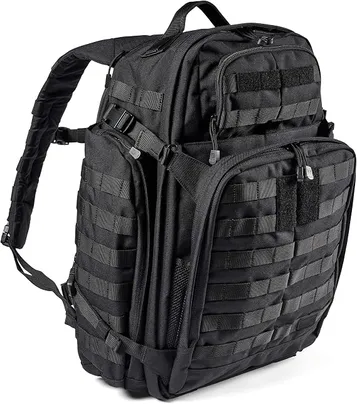

What Makes It Stand Out The RUSH72 2.0 is built from 1050D nylon — a fabric weight commonly used in military rucksacks — with self-repairing YKK zippers throughout. It includes a hidden CCW compartment separate from the main storage, a padded sleeve that fits up to a 15″ laptop, and a 3-liter hydration pocket. The wrap-around MOLLE platform is compatible with 5.11’s own Tier pouch system, so the bag can grow with your kit over time.
At 55 liters, it’s noticeably larger than most “3-day” tactical packs, which typically top out in the mid-40L range — giving you real room for a full loadout without needing an oversized 65L+ pack.
Pros
- Military-grade 1050D nylon and self-repairing zippers
- Hidden CCW compartment kept separate from general storage
- Unusually large 55L capacity for a 3-day-style pack
- MOLLE-compatible for modular add-ons
- Trusted, widely-issued brand among law enforcement and military
Cons
- Tactical styling draws attention — not a discreet, low-profile option
- Empty bag alone is heavier than ultralight alternatives
- Sold empty — no included food, water, or medical supplies
- Priced above unbranded MOLLE packs
Who Should Buy It Anyone who wants one pack built to last for years, with enough MOLLE real estate to customize as their kit grows, and who doesn’t mind a visibly tactical look.
2. Osprey Farpoint 55 — Best Low-Profile Bug Out Bag
Price: ~$180–$200 (often on sale closer to $125) | Pack Weight (empty): ~4.2 lbs | Best For: urban evacuation, “gray man” carry | Capacity: 55 liters (40L main + 15L detachable daypack)


What Makes It Stand Out The Farpoint 55 is a travel pack, not a tactical one — and that’s the point. An internal LightWire frame transfers weight onto a padded, breathable hip belt, and the whole harness stows away for a cleaner profile. The detachable 15L daypack can serve as a second, lighter grab bag on its own. Osprey rates the pack to carry loads up to 50 lbs comfortably.
Because it looks like an ordinary travel backpack rather than gear, it’s a solid pick if your evacuation plan involves passing through crowded or public spaces where you’d rather not stand out.
Pros
- Comfortable load-bearing hip belt and frame system
- Detachable 15L daypack doubles as a second bag
- Doesn’t look tactical — blends into everyday settings
- Lockable main compartment
Cons
- Top-loading design makes items at the bottom harder to reach
- Some reviewers find the daypack’s internal organization limited
- No hydration sleeve or CCW compartment
- No MOLLE webbing for attaching extra gear
Who Should Buy It People who want one bag that works for both bugging out and ordinary travel, and who value comfort and a low profile over tactical features.
3. Mystery Ranch 3-Day Assault CL — Best Compact/Agile Pack
Price: ~$300–$400 | Pack Weight (empty): ~4.6 lbs | Best For: agile get-home bag or minimalist bug out | Capacity: 30–33.8 liters


What Makes It Stand Out Made in the USA from 500D Cordura, the 3-Day Assault CL opens with Mystery Ranch’s signature 3-Zip design, which lays the pack open like a suitcase for full access to its contents. Front daisy chains and side PALS webbing allow lash-on gear, and a top-zip sleeve doubles as a laptop compartment or hydration pocket. Build quality is widely regarded as among the best in this category.
Several reviewers note that despite the “3-day” branding, the 30–34L capacity runs smaller than a true 72-hour loadout for one person — it fits better as a lighter, faster pack than a fully stocked family bug out bag.
Pros
- Exceptional build quality, made in the USA
- 3-Zip design gives fast, full access to contents
- Highly adjustable harness system for comfort under load
- Strong reputation for durability and resale value
Cons
- The most expensive pack on this list
- Capacity runs smaller than the “3-day” name implies
- Not consistently stocked through Amazon — check the manufacturer directly
- Premium price for a mid-size pack
Who Should Buy It Buyers who want the most durable pack available and are willing to pay for it — especially for a leaner loadout, solo travel, or as a get-home bag rather than a full family kit.
4. Maxpedition Falcon-II — Best for CCW Storage
Price: ~$150–$250 | Pack Weight (empty): ~3 lbs | Best For: solo carry with concealed firearm storage | Capacity: 23–25 liters


What Makes It Stand Out Built from 1050-denier, Teflon-coated nylon, the Falcon-II’s rear compartment includes an internal loop field that accommodates either a concealed firearm or a 3-liter hydration bladder — genuinely dual-purpose rather than a single dedicated slot. Five rows of PALS webbing and a full clamshell opening round out the organization. It’s a long-running favorite in the CCW-focused prepper community.
Its smaller footprint (23–25L) makes it easier to maneuver through doorways, vehicles, and tight urban spaces than the larger packs on this list.
Pros
- Dedicated compartment doubles as CCW or hydration storage
- Compact and easy to move through tight spaces
- Extensive PALS webbing for customization
- Teflon-coated fabric resists grime and light rain
Cons
- Smallest capacity on this list — not built for multi-day family loads
- Some reviewers describe the shoulder straps as less comfortable under a heavy load
- Higher price relative to its capacity compared with larger packs
Who Should Buy It Solo preppers or CCW holders who’d rather have a compact, well-organized pack with dedicated firearm storage than maximum capacity.
5. EVERLIT Complete 72 Hours (2-Person) — Best Pre-Packed Kit
Price: ~$130–$160 | Kit Weight (packed): ~20 lbs | Best For: a ready-now kit for two people | Capacity: N/A (sold pre-filled, not as an empty pack)

What Makes It Stand Out Unlike the other entries here, this bag already comes filled. It includes U.S. Coast Guard-approved emergency drinking water (24 pouches) and food bars rated for a 5-year shelf life, a 200-piece first aid kit with a CAT tourniquet, a 3-in-1 hand-crank flashlight/radio/phone charger, an emergency shelter, thermal blankets, and a poncho — all inside a water-resistant MOLLE backpack. The food and water allotment meets FEMA’s guideline of at least 1,000 calories per person per day.
It’s not a substitute for a well-curated custom kit, but it removes the biggest barrier to being prepared at all: actually assembling one.
Pros
- Ready to grab immediately — no separate shopping required
- Meets FEMA calorie guidelines for two people
- Comprehensive first aid kit that includes a real tourniquet
- 5-year shelf life on food and water components
Cons
- Heavier than an empty pack at roughly 20 lbs fully loaded
- Individual tools and gear are budget-tier, not premium
- Limited food variety for people with dietary restrictions
- Needs periodic checking to replace anything nearing expiration
Who Should Buy It Someone who wants a complete kit today without researching and buying dozens of individual items — a reasonable base to build on and upgrade over time.
6. REEBOW GEAR Tactical Backpack — Best Budget Option
Price: ~$40–$60 | Pack Weight (empty): Lighter-duty build than premium tactical brands | Best For: budget builds and outfitting multiple family members | Capacity: 35–40 liters


What Makes It Stand Out This is an unfilled MOLLE backpack made from 600x600D water-resistant fabric, with double-stitched heavy-duty zippers, side and front compression straps, and a hydration-bladder-compatible compartment — all at a fraction of the price of premium tactical brands. It won’t hold up to the years of hard use a 5.11 or Mystery Ranch pack can take, but the price makes it realistic to outfit an entire family without a premium-brand budget.
Pros
- Lowest price on this list by a wide margin
- Full MOLLE compatibility and hydration-ready design
- Reasonable 35–40L capacity for the price
- Practical for equipping multiple family members at once
Cons
- Water-resistant only, not fully waterproof
- Hardware and stitching quality trail premium brands
- No CCW compartment or laptop sleeve
- Less field-tested reputation than established tactical brands
Who Should Buy It Budget-conscious buyers, or families who need several bags without paying premium-brand prices for each one.
Links go to the manufacturer or Amazon’s current product listing. Prices, stock, and specifications change often — always confirm the current listing before buying.
Step-by-Step: Building Your Bug Out Bags
- Pick your bag size based on the duration and number of people it needs to cover, using the capacity table above.
- Lay out categories before you pack: water, food, first aid, tools, shelter/warmth, documents, and personal items. Packing by category prevents duplication and gaps.
- Pack heaviest items closest to your back and centered vertically — this keeps the load balanced and reduces strain.
- Keep frequently needed items accessible (flashlight, first aid, multitool) in outer pockets, not buried at the bottom.
- Weigh the packed bag and compare it to your body weight; adjust contents if it exceeds roughly 20% of your body weight.
- Test-carry it for at least 20–30 minutes to catch fit or balance issues before you actually need it.
- Set a recheck date — every six months, replace expired food and medication, update documents, and re-check seasonal clothing.
Bug Out Bags Packing Checklist
- Water: at least one day’s supply per person (about 1 gallon), plus a portable filter or purification tablets for ongoing needs
- Food: 72 hours of non-perishable, high-calorie food — canned protein, nut butter, dehydrated meals, energy bars
- First aid kit: bandages, antiseptic, any personal prescription medications, pain relievers
- Shelter and warmth: emergency blanket or bivvy, poncho, extra layer of clothing, warm socks
- Tools: multitool, fixed-blade knife, duct tape, paracord, flashlight or headlamp with spare batteries
- Fire: waterproof matches or a lighter, fire starter
- Documents: copies of ID, insurance papers, emergency contacts, some cash in small bills
- Communication: portable phone charger or hand-crank radio
- Hygiene: hand sanitizer, wet wipes, small toiletries
- Personal items: cash, a comfort item for children, spare glasses or contacts if needed
FAQs About Best Bug Out Bags
Are premade bug out bags worth buying? A premade kit can be a reasonable starting point if you want something ready immediately, but most pre-filled kits skimp on food quantity, water purification, and personal medications. Treat a premade kit as a base to build on, not a finished solution — check its contents against a full checklist and fill the gaps.
How long should a bug out bag last? Most are built around a 72-hour standard, since that’s typically the window before major relief efforts reach most areas. People in regions prone to longer disruptions — extended wildfire seasons or hurricane recovery zones — often plan for five to seven days instead.
What food should go in bug out bags? Choose non-perishable, high-calorie, low-prep food that covers protein, fat, and carbohydrates: canned fish, beans, and vegetables, nut butter and nuts, dehydrated fruit, whole-grain crackers, and ready-to-eat meal pouches. Avoid anything that needs extensive cooking or refrigeration.
How heavy should a bug out bag be? As a general guideline, keep the loaded weight under about 20% of your body weight if you might need to carry it any real distance on foot. Beyond that, fatigue and injury risk climb quickly, especially over uneven terrain.
Do I need separate bug out bags for each family member? Yes, where possible. Each adult and capable child should carry their own bag sized to their strength, with shared bulk items (larger first aid kit, tent, cooking gear) split reasonably across the group so no single bag becomes a point of failure.
What’s the difference between bug out bags and get-home bags? A get-home bag is smaller and built to help you travel a shorter distance — typically from work or your car back home — within a day. A bug out bag is larger and meant to sustain you for 72 hours or more away from home entirely.
Where should I store my bug out bag? Keep it somewhere accessible near an exit — a hall closet, mudroom, or vehicle trunk — rather than in an attic or basement that could be hard to reach quickly. If you spend significant time away from home, consider a smaller secondary kit at work or in your car.
Final Verdict (Best Bug Out Bags)
If you only take one thing from this guide: match the bag to how you’d actually use it, not to the biggest name or the longest feature list. For most people building a single, all-purpose 72-hour bag, the 5.11 RUSH72 2.0 is the safest default — it covers capacity, durability, and CCW storage in one well-reviewed pack. If blending in matters more than tactical features, the Osprey Farpoint 55 is the better fit. If you’d rather have something ready today than spend a weekend shopping, EVERLIT’s pre-packed kit gets you there fastest, with room to upgrade later.
Whichever bag you choose, the bag itself is only half the job. A well-chosen pack that’s never been loaded, weighed, or worn is still a gamble in an actual emergency — the packing checklist and test-carry steps above matter just as much as which bag you buy.
Also read: Best 72-Hour Survival Kits: Emergency Preparedness Reviewed
About This Guide: Best Kit Blog independently researches emergency preparedness gear by comparing manufacturer specifications and cross-checking owner reviews across multiple retailers — not through paid placements. Some links in this article are affiliate links, meaning we may earn a commission if you make a purchase, at no extra cost to you. That never determines which products are recommended or how they’re ranked.
Have a question this guide didn’t answer? Let us know and we’ll help you figure out the right bug out bag for your situation.