
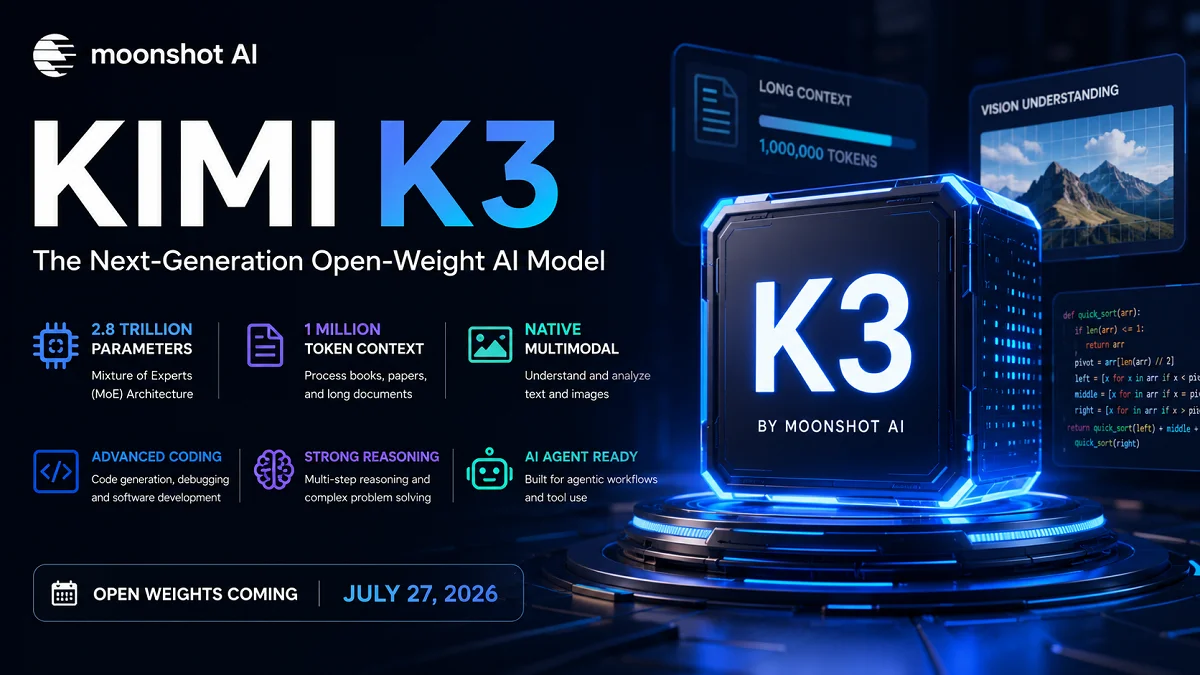
Kimi K3 Launch: World’s Largest Open AI Model Explained
The launch of Kimi K3 marks one of the biggest artificial intelligence announcements of 2026. Developed by Chinese AI startup Moonshot AI, Kimi K3 introduces a massive open-weight large language model that aims to compete with leading proprietary AI systems from companies such as OpenAI and Anthropic.
Unlike many recent AI releases that remain closed, Kimi K3 is designed to be openly available to developers while offering advanced reasoning, coding, visual understanding, and long-context processing. Its release has quickly attracted attention from developers, businesses, researchers, and investors worldwide because of its ambitious scale and competitive performance claims.
Quick Answer: Kimi K3 is Moonshot AI’s latest open-weight AI model with 2.8 trillion parameters, a 1 million-token context window, native vision support, and strong coding and reasoning capabilities. It is positioned as one of the most capable open AI models available today and is expected to challenge leading commercial AI systems.
What Is Kimi K3?
Kimi K3 is the latest flagship artificial intelligence model developed by Moonshot AI, a Chinese AI startup known for its Kimi AI assistant. It is an open-weight large language model (LLM) designed to handle advanced reasoning, coding, research, and multimodal tasks. Unlike many proprietary AI models, Moonshot AI plans to make Kimi K3’s model weights publicly available, giving developers more freedom to customize and deploy it for different applications.
The model is built using a Mixture of Experts (MoE) architecture with approximately 2.8 trillion parameters, making it the largest announced open-weight AI model to date. It also supports a 1 million-token context window, allowing users to analyze lengthy documents, large codebases, research papers, and other extensive datasets within a single conversation.
Kimi K3 is designed to deliver strong performance across a wide range of AI tasks, including:
- Advanced reasoning and problem-solving
- Software development and code generation
- Long-document analysis and summarization
- Native image understanding (multimodal AI)
- AI agents and workflow automation
- Research, education, and enterprise applications
With these capabilities, Kimi K3 is suitable for developers, researchers, businesses, and students looking for a powerful AI model. Its combination of advanced reasoning, long-context processing, native vision support, and competitive API pricing positions it as one of the strongest open AI models currently available and a serious competitor to leading commercial AI systems.
What Makes Kimi K3 Different?
Kimi K3 enters a highly competitive AI market, but several features help it stand out from many existing large language models. Instead of focusing only on chatbot conversations, Moonshot AI has designed Kimi K3 to handle complex reasoning, long-context understanding, software development, and AI agent workflows. Its combination of massive scale, open-weight availability, and advanced multimodal capabilities makes it one of the most ambitious AI models released so far.
Some of the biggest differences include:
- Open-weight architecture: Developers can customize and fine-tune the model instead of relying only on a closed cloud service.
- 2.8 trillion parameters: It is the largest announced open-weight AI model, using a Mixture of Experts (MoE) architecture for greater efficiency.
- 1 million-token context window: Users can process books, research papers, large codebases, and lengthy business documents in a single conversation.
- Native multimodal support: Kimi K3 understands both text and images, enabling richer AI interactions.
- Strong reasoning and coding abilities: The model is built for complex problem-solving, software engineering, and AI agent tasks.
- Competitive API pricing: Moonshot AI aims to make advanced AI capabilities more affordable for developers and businesses.
These capabilities position Kimi K3 as a strong alternative to many leading commercial AI models, particularly for developers and organizations that value openness, flexibility, and the ability to work with large amounts of information efficiently.
1 Million-Token Context Window
One of Kimi K3’s standout features is its ability to process up to 1 million tokens in a single conversation.
This allows users to analyze:
- Entire books
- Long research papers
- Large code repositories
- Legal contracts
- Business reports
- Multi-document projects
Instead of breaking documents into smaller pieces, users can often work with complete datasets in one session.
Native Vision Capabilities
Unlike text-only models, Kimi K3 can understand visual information alongside written prompts.
This enables workflows involving:
- Images
- Screenshots
- Charts
- Diagrams
- Technical illustrations
Developers can combine text and images without switching between multiple AI systems.
Kimi K3 Features at a Glance
Kimi K3 combines several advanced AI capabilities into a single model, making it suitable for developers, businesses, researchers, and everyday users. From handling extremely long documents to solving complex coding tasks, the model is designed to support a wide variety of real-world applications while remaining more open and flexible than many competing AI systems.
| Feature | Kimi K3 |
|---|---|
| Developer | Moonshot AI |
| Model Type | Open-weight Large Language Model (LLM) |
| Architecture | Mixture of Experts (MoE) |
| Total Parameters | 2.8 Trillion |
| Context Window | Up to 1 Million Tokens |
| Multimodal Support | Yes (Text + Images) |
| Reasoning Capability | Advanced multi-step reasoning |
| Coding Support | Code generation, debugging, and software development |
| Long Document Analysis | Yes |
| AI Agent Support | Yes |
| API Availability | Yes |
| Target Users | Developers, businesses, researchers, students, and enterprises |
| Model Weights | Planned public release by July 27, 2026 |
Specifications are based on Moonshot AI’s official announcement and may evolve with future updates.
Key Highlights
- Largest announced open-weight AI model with approximately 2.8 trillion parameters.
- Supports a 1 million-token context window for analyzing books, reports, and large codebases.
- Built with a Mixture of Experts (MoE) architecture for efficient performance.
- Understands both text and images through native multimodal capabilities.
- Optimized for reasoning, coding, research, and AI agent workflows.
- Available through Kimi AI, Kimi Code, Kimi Work, and the Kimi API for developers and businesses.
Benchmark Performance
Moonshot AI says Kimi K3 delivers competitive performance across several industry-standard AI benchmarks that measure reasoning, coding, mathematics, and real-world agent capabilities. According to the company, the model performs on par with, and in some cases exceeds, many leading open-weight AI models while approaching the performance of several proprietary frontier models.
Although benchmark scores provide a useful indication of a model’s capabilities, they do not always reflect real-world performance. Independent testing by researchers and developers over the coming months will provide a clearer picture of how Kimi K3 performs across different tasks and industries.
Based on Moonshot AI’s published results, Kimi K3 demonstrates strong performance in:
- Advanced reasoning and logical problem-solving
- Software engineering and code generation
- AI agent and tool-use tasks
- Mathematics and scientific reasoning
- Knowledge-intensive question answering
- Long-context document understanding
These early benchmark results suggest that Kimi K3 is well suited for demanding applications such as enterprise automation, research, software development, and large-scale document analysis. However, as with any newly released AI model, real-world evaluations from independent users will ultimately determine how consistently it performs across different workloads and use cases.
Why the AI Industry Is Paying Attention
The launch of Kimi K3 has attracted global attention because it demonstrates how quickly open AI models are advancing. For several years, the most powerful AI systems have largely come from a small group of companies offering proprietary models. Kimi K3 challenges that trend by delivering high-end capabilities through an open-weight model that developers can customize and deploy more freely.
Another reason for the growing interest is the model’s impressive technical scale. With 2.8 trillion parameters, a 1 million-token context window, and native multimodal support, Kimi K3 competes in areas that were previously dominated by closed commercial AI systems. This raises the standard for future open-weight models and increases competition across the AI industry.
Industry experts are paying close attention to Kimi K3 because it offers:
- A new benchmark for large open-weight AI models
- Greater flexibility for developers and enterprise users
- Competitive API pricing for commercial applications
- Advanced reasoning, coding, and AI agent capabilities
- Strong competition for leading proprietary AI models
- Faster innovation through open AI research and development
For businesses, the release of Kimi K3 means more choices when selecting AI platforms. For developers and researchers, it provides access to a powerful model that can be adapted for custom applications. As competition continues to grow among AI companies worldwide, launches like Kimi K3 are expected to accelerate innovation, improve AI performance, and make advanced AI technology more accessible to organizations of all sizes.
API Pricing
Alongside the launch of Kimi K3, Moonshot AI introduced competitive API pricing aimed at developers, startups, and enterprise customers. The pricing model is based on the number of tokens processed, allowing users to pay only for the AI resources they consume. This approach makes it easier for businesses to estimate costs when integrating Kimi K3 into applications, websites, and AI-powered services.
Compared with many premium AI APIs, Kimi K3’s pricing is positioned as a cost-effective option while still offering advanced reasoning, coding, and long-context capabilities. Organizations building chatbots, coding assistants, research tools, or enterprise automation platforms may find the pricing attractive for large-scale deployments.
| API Usage | Price (per million tokens) |
|---|---|
| Cache-hit Input | $0.30 |
| Cache-miss Input | $3.00 |
| Output Tokens | $15.00 |
What Do These Pricing Terms Mean?
- Cache-hit Input: Lower-cost requests where previously processed input can be reused, reducing computation.
- Cache-miss Input: New input that requires the model to perform full processing.
- Output Tokens: The text generated by Kimi K3 in response to user prompts.
Moonshot AI may update its API pricing over time as the platform evolves. Developers should always check the official Kimi documentation for the latest pricing, usage limits, and available API plans before deploying production applications.
Availability
Kimi K3 is now available through Moonshot AI’s ecosystem, giving both individual users and developers access to its advanced AI capabilities. Users can interact with the model through Kimi’s official AI assistant, while developers can integrate it into their own applications using the Kimi API.
The company has also announced plans to release the model’s open weights, allowing researchers and organizations to run, customize, and fine-tune Kimi K3 for their own projects. This open-weight approach is one of the key reasons the model has gained significant attention within the AI community.
Where You Can Access Kimi K3
| Platform | Purpose |
|---|---|
| Kimi AI | General AI conversations, writing, research, and productivity tasks |
| Kimi Code | Software development, code generation, debugging, and programming assistance |
| Kimi Work | Enterprise productivity, document analysis, and workplace collaboration |
| Kimi API | Enables developers to integrate Kimi K3 into applications, websites, and AI-powered services |
According to Moonshot AI, the full Kimi K3 model weights are planned for release by July 27, 2026, enabling broader adoption by developers, researchers, and enterprises. Availability may vary by platform and region as the rollout continues, and additional features are expected to be introduced through future updates.
How Kimi K3 Compares with Typical AI Models
With so many AI models now available, choosing the right one can be challenging. Kimi K3 distinguishes itself by combining an open-weight architecture, an extremely large context window, and advanced reasoning capabilities in a single platform. While many AI models offer similar core features such as text generation and coding assistance, Kimi K3 places a stronger emphasis on openness, flexibility, and handling large-scale tasks.
The comparison below highlights how Kimi K3 differs from a typical modern AI model.
| Feature | Kimi K3 | Typical AI Models |
|---|---|---|
| Model Type | Open-weight | Often proprietary or closed |
| Architecture | Mixture of Experts (MoE) | Standard Transformer or MoE |
| Parameters | 2.8 Trillion | Varies by model |
| Context Window | Up to 1 Million Tokens | Usually much smaller |
| Text Generation | ✔ Yes | ✔ Yes |
| Image Understanding | ✔ Native multimodal support | Available on some models |
| Advanced Reasoning | ✔ Strong focus | Varies |
| Coding Assistance | ✔ Advanced | Common but varies in quality |
| AI Agent Support | ✔ Yes | Limited on many models |
| API Access | ✔ Available | Usually available |
| Customization | High (Open weights) | Often limited |
| Enterprise Deployment | Supported | Depends on the provider |
Although Kimi K3 offers several advanced features, the best AI model still depends on the user’s needs. Businesses may prioritize security and enterprise support, developers may value open weights and customization, while casual users may simply want a fast and reliable AI assistant.
Overall, Kimi K3 stands out because it combines massive scale, long-context processing, multimodal capabilities, and an open-weight approach, making it one of the most capable and flexible AI models available for developers, researchers, and enterprise users.
Potential Use Cases
Kimi K3 is designed to support a wide range of real-world applications, making it useful for individuals, businesses, developers, researchers, and educational institutions. Its advanced reasoning, coding capabilities, long-context processing, and multimodal support enable it to handle everything from everyday productivity tasks to complex enterprise workflows.
Below are some of the most common ways Kimi K3 can be used.
Software Development
Developers can use Kimi K3 to write, explain, review, and debug code across multiple programming languages. It can also analyze large codebases, generate documentation, suggest improvements, and assist with software testing, making development faster and more efficient.
Research and Data Analysis
Researchers can use Kimi K3 to summarize lengthy research papers, compare multiple sources, extract key findings, and organize large amounts of information. Its long-context window makes it especially useful for analyzing extensive reports and technical documents.
Business and Enterprise Work
Organizations can use Kimi K3 to automate repetitive tasks, generate reports, analyze business documents, create meeting summaries, and improve internal knowledge management. It can also assist customer support teams by providing faster and more accurate responses.
Education and Learning
Students and educators can use Kimi K3 to explain difficult concepts, summarize textbooks, generate study notes, solve coding problems, and support academic research. It can also help create quizzes, lesson plans, and educational content.
Content Creation and Marketing
Writers, marketers, and content creators can use Kimi K3 to brainstorm ideas, draft articles, write social media posts, create marketing copy, and edit existing content. Its ability to understand long documents also makes it useful for rewriting and improving large pieces of content.
AI Agents and Workflow Automation
Kimi K3 is built to support AI agents that can complete multi-step tasks with minimal human input. Businesses can use it to automate workflows such as data processing, document management, scheduling, customer service, and software operations.
Key Use Cases at a Glance
- Software development and code generation
- Research and long-document analysis
- Enterprise automation and business productivity
- Education and personalized learning
- Content writing and digital marketing
- Customer support and AI-powered assistants
- AI agents and workflow automation
- Knowledge management and document summarization
With its combination of advanced reasoning, multimodal understanding, and support for large-scale data processing, Kimi K3 is well suited for both everyday productivity tasks and complex professional applications across multiple industries.
Practical Tips Before Using Kimi K3
If you plan to try Kimi K3, consider these recommendations:
- Use detailed prompts for complex tasks.
- Take advantage of the long context window for large documents.
- Verify factual information before publication.
- Compare results with other AI models for critical work.
- Review API pricing before deploying production applications.
- Monitor future updates as additional reasoning modes become available.
Current Limitations
Although Kimi K3 introduces impressive capabilities, users should keep several limitations in mind.
- Early benchmark results come largely from the developer and will need broader independent validation.
- Running a model of this scale locally will require significant computing resources, making cloud deployment the practical option for most users.
- Moonshot AI acknowledges that some proprietary frontier models may still provide a better overall user experience in certain scenarios.
Why This Launch Matters
The launch of Kimi K3 is more than just another AI product announcement—it represents an important milestone in the evolution of open-weight artificial intelligence. As AI competition continues to grow worldwide, Kimi K3 shows that powerful, developer-friendly models are becoming more accessible, giving organizations more choices beyond proprietary platforms.
For developers and businesses, Kimi K3 offers the opportunity to build AI-powered applications using a model that combines advanced reasoning, long-context processing, and multimodal capabilities. Its open-weight approach also provides greater flexibility for customization, research, and enterprise deployment, which can accelerate innovation across different industries.
Why Kimi K3 Is Significant
- Demonstrates the rapid progress of open-weight AI models.
- Increases competition among leading global AI companies.
- Gives developers greater flexibility through planned open model weights.
- Supports advanced applications such as AI agents, software development, and enterprise automation.
- Encourages wider adoption of AI by offering competitive API pricing.
As more companies invest in increasingly capable AI systems, launches like Kimi K3 are expected to drive faster innovation, lower development costs, and expand access to advanced AI technologies. Whether its long-term performance matches early expectations will depend on independent testing and real-world adoption, but its release has already become one of the most important AI announcements of 2026.
Frequently Asked Questions
Is Kimi K3 open source?
Moonshot AI describes Kimi K3 as an open-weight model, with full model weights planned for release after launch. While often referred to as open, users should review the final license terms when the weights become available.
How many parameters does Kimi K3 have?
Kimi K3 contains approximately 2.8 trillion parameters, making it the largest announced open-weight AI model to date.
Does Kimi K3 support images?
Yes. The model includes native vision capabilities that allow it to process images alongside text.
What is the context window of Kimi K3?
Kimi K3 supports up to 1 million tokens, enabling analysis of extremely large documents and datasets.
Can developers access Kimi K3 through an API?
Yes. Moonshot AI provides API access along with pricing for developers and enterprise users.
Final Thoughts
Kimi K3 is one of the most significant AI releases of 2026. By combining an enormous parameter count, a 1 million-token context window, native vision support, advanced reasoning, and competitive pricing, Moonshot AI has positioned itself as a serious competitor in the rapidly evolving AI landscape.
Although independent testing over the coming weeks will provide a clearer picture of its real-world strengths and limitations, Kimi K3 has already demonstrated that open-weight AI models continue to close the gap with the industry’s leading proprietary systems. For developers, researchers, businesses, and AI enthusiasts, it is a launch worth watching closely as the next phase of artificial intelligence competition unfolds.
Also read: GPT-5.6 Released Globally: New Features, Models & Pricing


